
By the Dental Health Desk
For millions of people living with missing or failing teeth, the idea of waking up with a complete, fixed set of teeth in a single day once sounded like science fiction. Today it is routine dentistry. Full-arch implant solutions have changed the way clinics around the world treat patients who have lost most or all of their teeth, and two names dominate the conversation: All-on-4 and All-on-6.
On the surface, the difference looks simple. One uses four implants per jaw, the other uses six. But as specialists keep reminding patients, the choice is rarely just about numbers. It depends on bone quality, jaw anatomy, bite forces, budget and long-term goals. In this report, we break down what each treatment involves, how they compare, and how to decide which one may suit you.
What Are Full-Arch Dental Implants?
A full-arch implant treatment replaces an entire row of teeth, upper or lower, using a small number of titanium implants placed in the jawbone. Rather than fitting one implant for every missing tooth, the dentist anchors a single fixed bridge onto a handful of strategically placed implants.
The benefits over traditional removable dentures are well documented. Fixed teeth do not slip, click or need adhesive. They allow patients to eat a wider range of foods, speak more clearly, and they stimulate the jawbone in a way dentures cannot, which helps slow the bone loss that follows tooth loss.
Both All-on-4 and All-on-6 follow this principle. The difference lies in how many implants carry the bridge and how they are positioned.
All-on-4 Explained
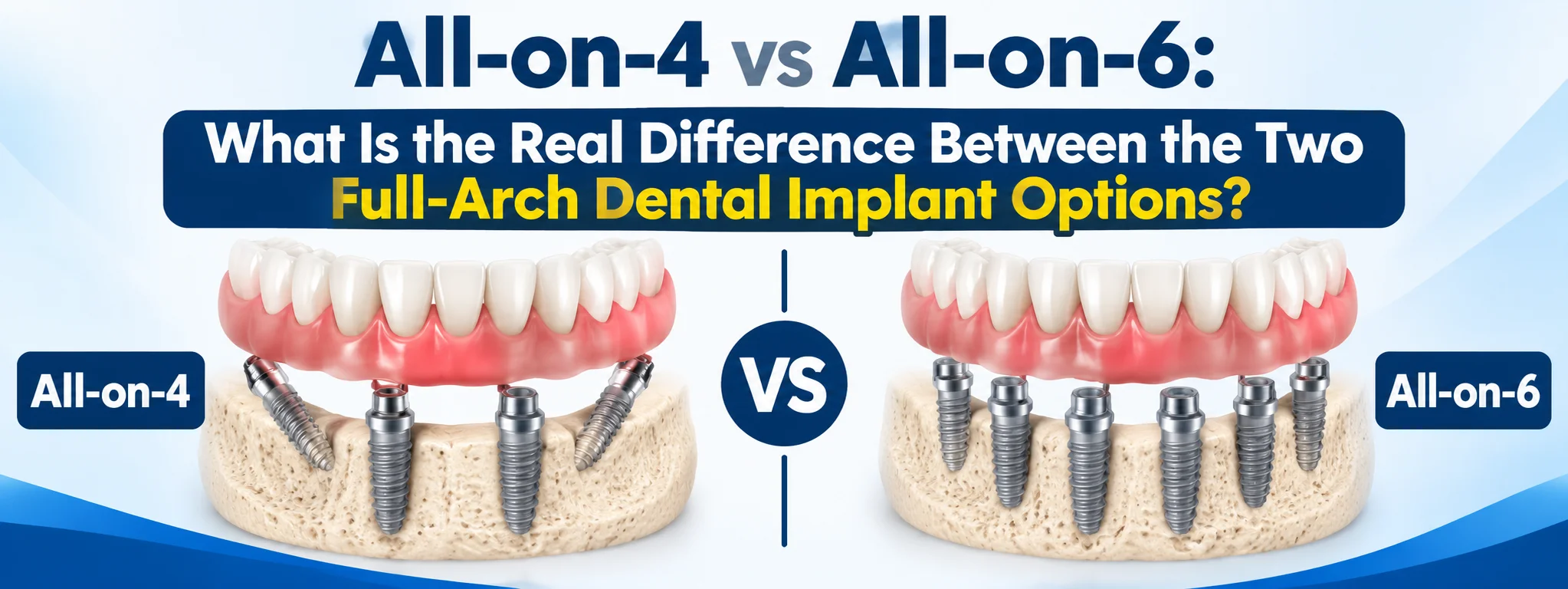
All-on-4 was developed in the late 1990s as a way to give patients with significant bone loss a fixed solution without lengthy bone grafting. The concept is to use four implants per jaw: two placed at the front, usually straight, and two placed at the back at an angle, typically between 30 and 45 degrees.
That tilt is the clever part. By angling the rear implants, the surgeon can make use of denser bone toward the front of the jaw and avoid anatomical structures such as the sinuses in the upper jaw or the nerve channel in the lower jaw. The angled implants also allow a longer implant to be used, which increases contact with the bone and improves stability.
A full bridge, commonly made of acrylic over a titanium frame or of zirconia, is then attached. In many cases, a temporary bridge can be fitted on the same day as surgery, which is why the treatment is often described as “teeth in a day.”
Typical advantages of All-on-4:
- Fewer implants, so a shorter and less invasive surgery
- Often avoids bone grafting
- Generally lower cost than using more implants
- Quick results with an immediate temporary bridge
All-on-6 Explained
All-on-6 is built on the same philosophy but adds two more implants to each arch. Usually, the implants are distributed more evenly along the jaw, and in many cases they are placed straighter, with less reliance on tilted positions.
Six implants spread the chewing load across a wider area. The bridge has additional points of support, which can be especially valuable in the back of the mouth, where biting forces are strongest. It also means that if one implant has a problem, the remaining implants may be better able to continue supporting the bridge while the issue is managed.
Typical advantages of All-on-6:
- Greater stability and load distribution
- A longer span of the bridge is better supported, reducing flexing
- Useful for softer bone, particularly in the upper jaw
- More flexibility if one implant does not integrate as expected
- Often a more comfortable option for patients who bite hard or grind their teeth
The Key Differences at a Glance
Number and position of implants. All-on-4 uses four implants, two of them angled. All-on-6 uses six, usually more evenly distributed and sometimes with less angulation.
Support and stability. Both are considered reliable, and long-term studies of All-on-4 report high survival rates over many years. However, six implants naturally share the load across more points, which can be an advantage for patients with heavier bite forces.
Bone requirements. All-on-4 was designed for patients with limited bone, because tilted implants can bypass weaker areas. All-on-6 usually needs enough bone to place six implants properly, though in the right candidate it can offer more security. In the upper jaw, where bone is typically softer, many surgeons lean toward six implants.
Surgery and recovery. Because All-on-4 involves fewer implants, surgery can be slightly shorter and recovery slightly easier. The difference is usually modest, as both are performed with the same careful approach and aftercare.
Cost. Two additional implants mean additional materials and surgical time, so All-on-6 generally costs more. The gap varies by clinic and country, and it should be weighed against the potential long-term benefits.
Bridge design. With six support points, the bridge can sometimes be designed with fewer or shorter cantilevers, which are the parts that extend beyond the last implant. Shorter cantilevers place less stress on the structure.
Who Is a Good Candidate for Each?
No two mouths are the same, and the right option is decided after a thorough examination, which should include a 3D scan or CBCT imaging to assess bone volume and density.
All-on-4 may be suitable for patients who have lost most or all of their teeth, who have limited bone height in the back of the jaw, who prefer to avoid grafting, or who are looking for a more economical full-arch solution.
All-on-6 may be better for patients with adequate bone who want maximum stability, those with strong bite forces or a tendency to grind their teeth, patients with softer upper-jaw bone, and those who prioritise long-term resilience over upfront savings.
Certain factors affect both treatments. Smoking, uncontrolled diabetes, gum disease and poor oral hygiene can raise the risk of implant failure, and a responsible clinic will address these before surgery.
What to Expect: Procedure and Recovery
The journey is broadly similar for both options. After consultation and scans, any remaining damaged teeth are removed, and the implants are placed under local anaesthesia, often with sedation for comfort. A temporary fixed bridge is usually attached within about a day, so patients leave with teeth.
In the following weeks, patients are advised to eat soft foods while the implants fuse with the bone, a process called osseointegration. Some swelling and bruising is normal in the first few days. After roughly three to six months, the final bridge is made and fitted, designed for a precise bite and a natural appearance.
Care afterwards is essential. Daily cleaning, including specialised brushes or water flossers under the bridge, plus regular check-ups, is what keeps the result healthy for years. Implants themselves can last decades with good care, while the bridge may need maintenance or replacement over time.
A Look at Dentalingo in Alanya
Dental tourism has grown rapidly on Turkey’s Mediterranean coast, and Alanya has become a popular destination for patients seeking full-arch solutions. Among the clinics serving international patients is Dentalingo, based in Alanya, which offers both All-on-4 and All-on-6 treatment planning tailored to each patient’s anatomy and goals.
As with any clinic, specialists advise patients to ask for a detailed treatment plan, understand which implant brands and materials will be used, and clarify what aftercare and warranty are provided. To learn more about the treatments on offer, take a look at the web.
Frequently Asked Questions
1. Is All-on-6 always better than All-on-4?
Not necessarily. More implants can mean more stability, but the best option depends on your bone, bite and budget. For some patients, a well-planned All-on-4 performs excellently for many years. For others, especially those with strong bite forces or softer bone, All-on-6 is the safer choice. Your dentist’s assessment matters more than the number.
2. Does the procedure hurt?
Surgery is performed under local anaesthesia, sometimes with sedation, so you should not feel pain during the procedure. Afterwards, discomfort, swelling and bruising are common for a few days and are usually managed with prescribed medication and cold compresses.
3. How long do full-arch implants last?
The implants themselves are designed to last many years, and often decades, when cared for properly. The bridge attached to them is subject to wear and may need repair or replacement after a number of years, depending on the material and your habits, such as grinding.
4. Can I get new teeth on the same day?
In many cases, yes. A temporary fixed bridge can often be fitted within about 24 hours of surgery, provided the implants achieve sufficient initial stability. The final, permanent bridge follows after healing.
5. Can I choose All-on-6 even if I have bone loss?
It depends on how much bone remains and where. If there is not enough bone to place six implants safely, your dentist may recommend All-on-4 with angled implants or suggest bone grafting first. A 3D scan will show which route is realistic.
The Bottom Line
All-on-4 and All-on-6 share the same goal: a fixed, natural-looking set of teeth that restores confidence and function. All-on-4 offers an efficient, cost-conscious path, particularly for patients with limited bone. All-on-6 adds extra support and resilience, which can pay off for those with heavier bites or softer bone.
The smartest first step is a proper consultation with imaging and a personalised plan. Whichever option you choose, the quality of planning, the surgeon’s experience and your own aftercare will shape the outcome far more than the number alone.
This article is for general information and does not replace professional dental advice. Consult a qualified dentist about your individual situation.