
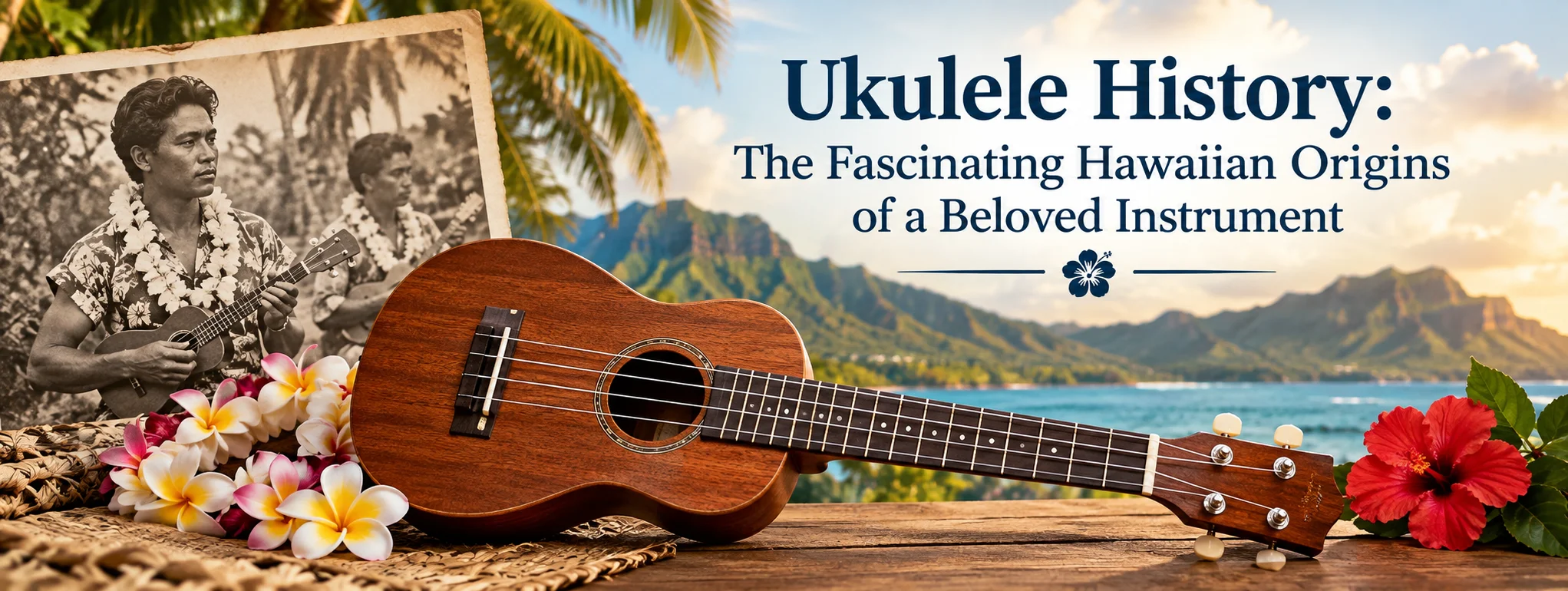
The ukulele history is a fascinating journey from the workshops of Portuguese instrument makers to the sunny shores of Hawaii and, eventually, music stages around the world. Known for its cheerful sound, compact size, and welcoming learning curve, the ukulele has become one of the most beloved string instruments in modern music. However, its story is much deeper than its familiar four strings and tropical image.
The instrument developed through cultural exchange, Hawaiian creativity, royal support, and generations of musicians who transformed a small guitar-like instrument into a powerful symbol of island identity. From its arrival in the nineteenth century to its place in contemporary pop, folk, jazz, and educational music, the ukulele has inspired millions of people to discover the joy of playing music.
Understanding its origins reveals how migration, tradition, and artistic innovation can create something extraordinary. Here is a closer look at the remarkable journey that made the ukulele a global musical treasure.
The Early Origins of the Ukulele
Although the ukulele is strongly associated with Hawaii, its earliest roots can be traced to Portugal. During the nineteenth century, Portuguese musicians played small, four-string instruments that were portable, lively, and suitable for accompanying songs and dances.
One particularly important instrument was the machete, a small guitar-like instrument from Madeira. It was also associated with related Portuguese instruments, including the braguinha and the cavaquinho. These instruments shared characteristics that later became familiar in the ukulele.
Portuguese Immigration to Hawaii
In 1879, Portuguese immigrants from Madeira arrived in Hawaii aboard the ship Ravenscrag. Many had traveled to the islands to work in the expanding sugar industry. Along with their belongings, traditions, food, and language, they brought their musical heritage.
Among the immigrants were skilled craftsmen and musicians who helped introduce Portuguese string instruments to Hawaiian communities. Their instruments quickly attracted attention because of their distinctive sound, convenient size, and lively playing style.
The arrival of these musicians created an important cultural connection between Portugal and Hawaii. Although the ukulele did not emerge fully formed on the day they arrived, their instruments and craftsmanship helped establish the foundation for its development.
The Craftsmen Who Helped Shape the Instrument
Several Portuguese immigrants became especially important in the early history of the ukulele. Manuel Nunes, Augusto Dias, and José do Espírito Santo are commonly associated with the instrument’s development in Hawaii.
These craftsmen brought knowledge of traditional instrument making and adapted their designs to local materials, musical preferences, and playing styles. Their work helped transform Portuguese-inspired instruments into a distinctly Hawaiian creation.
This process demonstrates that musical instruments rarely develop in isolation. They evolve as people travel, exchange ideas, and adapt familiar traditions to new surroundings.
How the Ukulele Got Its Name
The name ukulele is Hawaiian, and its meaning is commonly associated with the phrase “jumping flea.” One popular explanation connects the name to the quick, lively movements of a player’s fingers across the strings.
However, the precise origin of the name remains debated. Another interpretation links it to Edward Purvis, a British military officer and musician who lived in Hawaii during the nineteenth century. His small stature and energetic personality reportedly inspired the nickname, although this explanation is not universally accepted.
A Name That Captured Its Character
Whatever its exact origin, the name perfectly suits the instrument’s playful personality. The ukulele produces a bright, warm sound that can make a simple melody feel joyful and inviting.
Its Hawaiian name also reflects the cultural environment in which the instrument developed. Rather than remaining a Portuguese instrument with a foreign identity, it became part of Hawaii’s musical language.
Over time, the name gained international recognition. Today, people across continents recognize the word ukulele, even if they have never visited Hawaii or studied Hawaiian music.
Ukulele History and the Hawaiian Royal Family
The Hawaiian royal family played a significant role in the instrument’s early popularity. During the late nineteenth century, Hawaii was experiencing substantial political, economic, and cultural change. Music remained an important expression of identity, celebration, and community life.
King David Kalākaua, who ruled from 1874 to 1891, was a passionate supporter of Hawaiian arts and traditions. He encouraged music, dance, and cultural performances during his reign.
King David Kalākaua’s Cultural Influence
King Kalākaua is frequently associated with the promotion of Hawaiian music and the revival of traditional cultural practices. The ukulele gained visibility in royal and public gatherings, helping it become familiar among influential members of Hawaiian society.
The king’s interest in music created opportunities for musicians to perform and develop their craft. As the instrument appeared in celebrations and cultural events, its reputation expanded beyond immigrant communities.
Royal support did not single-handedly create the ukulele, but it helped strengthen its position within Hawaiian society. This recognition was especially important because it encouraged the instrument to become associated with the islands themselves rather than solely with its Portuguese origins.
Queen Liliʻuokalani and Hawaiian Music
Queen Liliʻuokalani, Hawaii’s last reigning monarch, was also an accomplished composer and musician. She created numerous songs, including the internationally recognized “Aloha ʻOe.”
Her musical legacy illustrates the richness of Hawaiian artistic traditions during the period when the ukulele was becoming established. Although the queen’s compositions should not all be attributed to the ukulele, her work provides important context for understanding the musical culture that surrounded its growth.
Together, the royal family’s support for music helped create an environment in which Hawaiian musicians could incorporate the instrument into local performances and develop distinctive playing styles.
How the Ukulele Became a Hawaiian Cultural Symbol
The ukulele gradually became much more than a portable string instrument. Hawaiian musicians embraced it, developed their own techniques, and incorporated it into a variety of musical settings.
Its adaptability made it suitable for singing, informal gatherings, traditional performances, and popular entertainment. The instrument could accompany gentle melodies or energetic rhythms without requiring a large ensemble.
The Development of Hawaiian Playing Styles
Hawaiian musicians explored different ways to play the ukulele, including rhythmic strumming, melodic fingerpicking, and techniques that emphasized the instrument’s natural warmth.
These styles allowed performers to accompany singers while also creating independent melodies. Over generations, musicians developed approaches that reflected Hawaii’s distinctive musical identity.
The ukulele became closely associated with Hawaiian songs, storytelling, and celebrations. Its sound also helped introduce audiences elsewhere to Hawaiian musical traditions.
Beyond the Tropical Image
Modern audiences sometimes associate the ukulele exclusively with beaches, palm trees, and vacation music. While the instrument certainly fits relaxed musical settings, this image tells only part of its story.
The ukulele has a history connected to migration, craftsmanship, cultural exchange, and the preservation of Hawaiian identity. Recognizing these influences gives the instrument greater meaning and helps listeners appreciate its origins more fully.
Its cultural importance extends beyond its cheerful tone. It represents the way communities can adapt outside influences while developing something uniquely their own.
The Ukulele’s Journey to Mainland America
The ukulele’s international popularity grew significantly during the early twentieth century. Performances, exhibitions, recordings, and touring musicians introduced the instrument to audiences outside Hawaii.
One major turning point came with the Panama-Pacific International Exposition in San Francisco in 1915. Hawaiian music and performances attracted considerable attention, helping stimulate public interest in the islands’ musical traditions.
The Rise of Hawaiian Music
During the early twentieth century, Hawaiian music became fashionable across parts of the United States. Audiences were captivated by its distinctive melodies, rhythmic accompaniment, and associations with a distant island culture.
The ukulele was small enough to transport easily and simple enough for many beginners to approach. These practical advantages helped it spread through music shops, entertainment venues, schools, and households.
Manufacturers responded to growing demand by producing instruments in larger quantities. As availability increased, more people could purchase a ukulele and learn popular songs.
The Ukulele in American Popular Culture
By the 1920s, the ukulele had become a familiar feature of American popular entertainment. It appeared in recordings, stage performances, and amateur music-making.
Its popularity was strengthened by performers who demonstrated its versatility and entertaining character. The instrument became especially attractive to beginners because a few basic chords could accompany many familiar songs.
This period helped establish the ukulele as an affordable and accessible musical instrument rather than a curiosity associated only with Hawaii.
A Timeline of Important Moments in Ukulele History
The following timeline highlights major developments that shaped the instrument’s evolution and worldwide recognition.
| Period | Important development |
|---|---|
| Before 1879 | Portuguese communities in Madeira and elsewhere play small, guitar-like string instruments. |
| 1879 | Portuguese immigrants from Madeira arrive in Hawaii, bringing musical traditions and instruments. |
| Late 1800s | Hawaiian craftsmen develop the ukulele from Portuguese-inspired designs. |
| Late 1800s | King David Kalākaua’s support for Hawaiian arts helps the instrument gain cultural visibility. |
| 1915 | Hawaiian performances at the Panama-Pacific International Exposition introduce the music to wider American audiences. |
| 1920s | The ukulele becomes popular in American entertainment and household music-making. |
| Mid-1900s | Television, popular performers, and educational use help maintain interest in the instrument. |
| Late 1900s to 2000s | Renewed performances, recordings, and online communities expand its international reach. |
| Today | The ukulele remains popular in schools, homes, live performances, and digital music communities. |
The timeline shows that the ukulele’s success was not the result of one event. Instead, it developed through a series of cultural encounters, creative adaptations, and changing musical tastes.
The Ukulele’s Evolution Through the Twentieth Century
Although its popularity rose rapidly in the 1920s, the ukulele experienced changing levels of attention throughout the twentieth century. Musical fashions shifted, and other instruments sometimes dominated commercial entertainment.
Nevertheless, the ukulele continued to attract dedicated players. Its portability and approachable design made it useful for music education, family gatherings, songwriting, and informal performances.
Television and Popular Performers
Television helped introduce the ukulele to new generations. One particularly famous performer was Arthur Godfrey, whose television appearances and instructional materials encouraged many Americans to learn the instrument during the mid-twentieth century.
His influence helped reinforce the ukulele’s reputation as an instrument that ordinary people could enjoy without years of formal training.
Other musicians also demonstrated that the ukulele could support comedy, sophisticated arrangements, and expressive solo performances. These examples challenged the idea that the instrument was limited to simple accompaniment.
A Fresh Wave of Interest
Later in the twentieth century and into the twenty-first century, the ukulele experienced renewed popularity through recordings, live performances, online tutorials, and social media.
Musicians began using it in genres ranging from indie pop and folk to jazz and contemporary acoustic music. Its recognizable tone made it a distinctive choice for both stripped-down arrangements and creative reinterpretations of familiar songs.
This renewed attention helped introduce the instrument to people who might never have encountered traditional Hawaiian music otherwise.
Why the Ukulele Remains Popular Today
The modern ukulele combines a rich cultural background with practical advantages that make it attractive to beginners and experienced musicians alike.
Its small body is easy to carry, its nylon or similar synthetic strings are generally comfortable for beginners, and many common songs can be played using only a handful of chords.
Five reasons the ukulele continues to attract new players include:
- Beginner-friendly learning: Basic chords and simple strumming patterns can be learned relatively quickly.
- Portable design: Its compact size makes it convenient for travel, school, and outdoor gatherings.
- Affordable options: Many entry-level instruments are available at accessible prices, although quality varies.
- Musical flexibility: Players can explore pop, folk, jazz, traditional Hawaiian music, and original compositions.
- Community connection: Group lessons, online tutorials, and informal jam sessions make learning more social and enjoyable.
The Different Types of Ukulele
Modern ukuleles are available in several sizes, each offering a slightly different sound and playing experience.
The soprano is the smallest and is often associated with the classic ukulele sound. The concert model offers a little more room for the fingers, while the tenor has a larger body and a fuller voice. The baritone is the largest of these common types and is generally tuned differently from the other three.
Choosing the right size depends on comfort, musical goals, and preferred sound. Beginners should consider trying different sizes when possible rather than assuming the smallest model is automatically the best choice.
Learning From the Instrument’s Cultural Roots
For new players, learning about the ukulele’s history can make the experience more rewarding. Understanding its Portuguese connections and Hawaiian development helps explain why the instrument sounds and looks the way it does today.
It also encourages greater appreciation for Hawaiian musicians and the cultural traditions that shaped its identity. Exploring traditional Hawaiian songs alongside modern arrangements provides a broader understanding of the instrument’s expressive possibilities.
Final Thoughts
The story of ukulele history is a remarkable example of how music can cross borders and create lasting cultural connections. What began with Portuguese string-instrument traditions eventually developed into a distinctive Hawaiian instrument through the skill, creativity, and musical imagination of local craftsmen and performers.
Royal support, public performances, international exhibitions, and popular recordings helped carry the ukulele far beyond the Hawaiian Islands. Today, its familiar sound brings people together in classrooms, homes, concerts, and online communities.
Yet the instrument’s greatest achievement is not simply its worldwide popularity. It is the way it connects different cultures while retaining a strong association with Hawaii. Every strum reflects a history of movement, adaptation, and artistic expression.
Whether you are a beginner picking up your first ukulele or a musician exploring its heritage, discovering its origins adds another layer of appreciation. This small instrument has an extraordinary story, and its musical journey continues to inspire new generations around the world.
Frequently Asked Questions
1. Where did the ukulele originate?
The ukulele developed in Hawaii during the late nineteenth century from Portuguese-inspired string instruments brought by immigrants, particularly from Madeira.
2. Who invented the ukulele?
There is no single universally recognized inventor. Portuguese craftsmen Manuel Nunes, Augusto Dias, and José do Espírito Santo are commonly credited with helping develop the instrument in Hawaii.
3. Why is it called a ukulele?
The name is commonly interpreted as “jumping flea,” possibly referring to the rapid movement of a player’s fingers. The precise origin of the name remains debated.
4. When did the ukulele become popular in America?
The instrument gained significant attention in the early twentieth century, especially after Hawaiian music attracted audiences at the 1915 Panama-Pacific International Exposition.
5. Is the ukulele originally Hawaiian or Portuguese?
Its early design has Portuguese roots, but the modern ukulele developed in Hawaii. Both cultures are essential to understanding its history.