
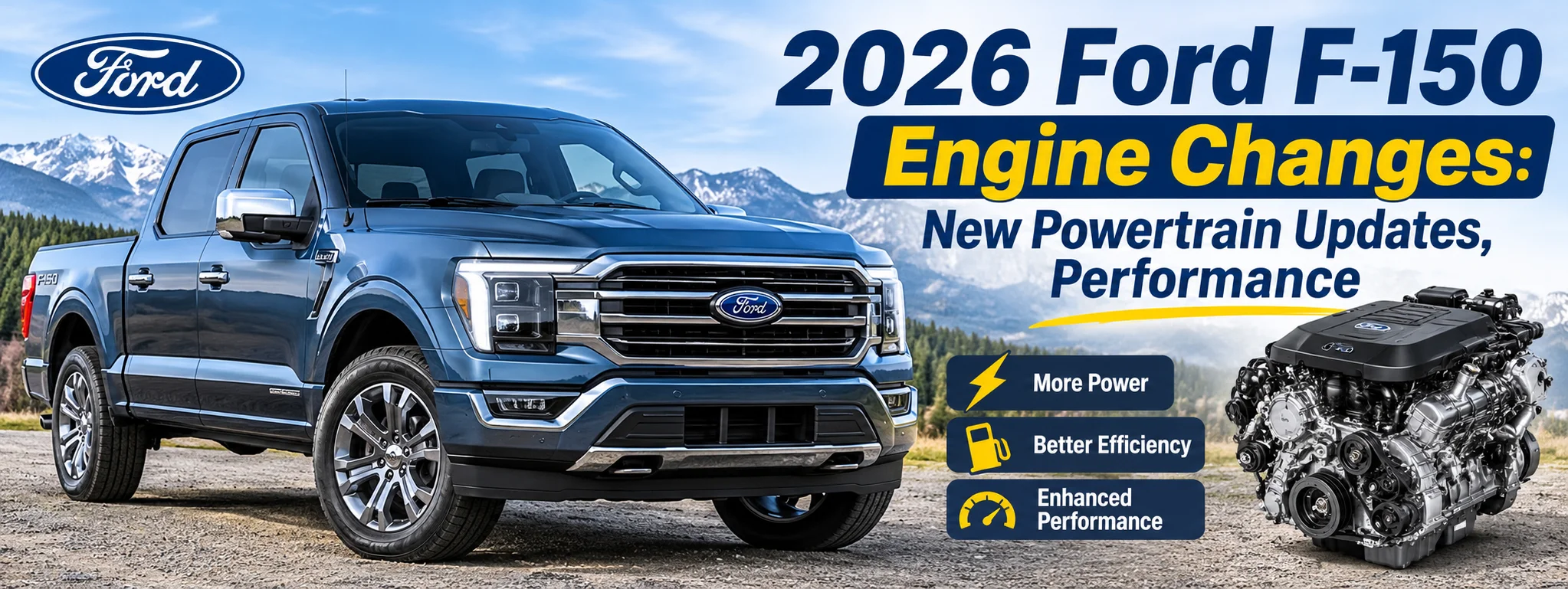
The 2026 Ford F-150 engine changes are an important topic for truck buyers who want to understand performance, towing capability, fuel economy, and available powertrain options before choosing their next pickup. The F-150 has built its reputation on offering several engine choices, allowing drivers to select a truck that suits everyday commuting, demanding work, heavy towing, or off-road adventures.
For the 2026 model year, buyers should pay attention to the available engine configurations, power delivery, transmission pairing, and differences between conventional gasoline and hybrid options. However, it is important to separate genuine model-year updates from features carried over from previous versions. Not every engine specification represents a completely redesigned powertrain.
2026 Ford F-150 engine changes, the expected powertrain lineup, performance considerations, towing-related features, and the details buyers should verify before placing an order. It also explains which engine may be the better choice for different driving needs.
What Is New About the 2026 Ford F-150 Engine Lineup?
The biggest development for the 2026 model year is not a completely new engine family. Instead, Ford has expanded powertrain availability and made its existing engine choices accessible across more configurations.
One of the most notable changes is the wider availability of the 3.5L PowerBoost Full Hybrid V6. Buyers can also explore different configurations of the traditional EcoBoost V6 and 5.0L V8, depending on the trim and equipment package.
Here are the main developments:
-
Expanded hybrid availability: The 3.5L PowerBoost hybrid is available on additional trim levels, including the STX.
-
More engine flexibility: Buyers have additional opportunities to select different engines across the F-150 lineup.
-
V8-powered STX Lobo package: The new street-focused package features a 5.0L V8 and distinctive exterior styling.
-
Continued EcoBoost options: The 2.7L and 3.5L turbocharged engines remain important choices.
-
Raptor performance: High-output EcoBoost and supercharged V8 engines continue to serve performance-focused Raptor models.
These updates make engine availability and trim selection especially important when comparing 2026 F-150 models. Ford’s official model-year information confirms that the changes focus on expanded availability and equipment rather than a complete powertrain redesign.
2026 Ford F-150 Engine Options and Specifications
The 2026 Ford F-150 offers a broad engine selection designed for different driving requirements. From smaller turbocharged engines to a naturally aspirated V8 and a full hybrid powertrain, each option has its own advantages.
The following table summarizes the advertised engine specifications on Ford’s US model information.
| Engine | Horsepower | Torque | Main purpose |
|---|---|---|---|
| 2.7L EcoBoost V6 | 325 hp | 400 lb-ft | Everyday driving |
| 3.5L EcoBoost V6 | 400 hp | 500 lb-ft | Towing and hauling |
| 3.5L PowerBoost Hybrid V6 | 430 hp | 578 lb-ft | Power and hybrid efficiency |
| 5.0L Ti-VCT V8 | 400 hp | 410 lb-ft | Traditional V8 performance |
| 3.5L High Output EcoBoost V6 | 450 hp | 510 lb-ft | Raptor performance |
| 5.2L Supercharged V8 | 720 hp | 640 lb-ft | Raptor R performance |
Specifications are based on Ford’s published US engine information. The high-output engines are Raptor-specific, and availability depends on trim and configuration.
2.7L EcoBoost V6: A Practical Everyday Engine
The 2.7L EcoBoost V6 remains an attractive option for drivers who want a capable pickup without selecting one of the larger engines.
It produces 325 horsepower and 400 lb-ft of torque. Its twin-turbocharged design helps deliver useful pulling power without requiring a large-displacement V8.
For everyday transportation, commuting, light work, and occasional recreational towing, this engine offers a sensible balance of performance and practicality.
Its main appeal includes:
-
Strong low-speed torque for normal driving.
-
Turbocharged performance in a relatively compact engine.
-
A useful option for drivers who do not regularly tow heavy trailers.
-
Access to F-150 capability without moving to a larger powertrain.
Buyers should still compare the truck’s actual towing and payload ratings rather than assuming every 2.7L model has the same capability.
3.5L EcoBoost V6: A Strong Choice for Towing
The 3.5L EcoBoost V6 is one of the most capable conventional gasoline engines available in the 2026 F-150.
Ford lists this engine at 400 horsepower and 500 lb-ft of torque. Its twin-turbocharged setup provides substantial pulling power, making it particularly attractive to people who regularly transport equipment, recreational vehicles, or work trailers.
Compared with the 2.7L EcoBoost, the 3.5L version delivers greater torque. This additional output can make a noticeable difference when carrying heavier loads or accelerating while towing.
It is worth considering for:
-
Regular trailer towing.
-
Construction and commercial work.
-
Drivers who need strong acceleration under load.
-
Buyers who want a powerful gasoline engine without choosing a V8.
For many truck owners, this engine represents a particularly useful balance between everyday performance and demanding work.
3.5L PowerBoost Full Hybrid V6: More Power With Hybrid Technology
One of the most interesting parts of the 2026 Ford F-150 engine changes is the expanded availability of the PowerBoost hybrid system.
This powertrain combines a 3.5L EcoBoost V6 with an electric motor and hybrid battery technology. The system produces an advertised 430 horsepower and 578 lb-ft of torque.
Unlike a conventional gasoline engine, the hybrid system can combine electric assistance with engine power to provide strong acceleration and improved flexibility in certain driving conditions.
Another important feature is available Pro Power Onboard, which allows the truck to supply electricity to compatible tools, appliances, and equipment.
This can be particularly useful for people who work outdoors, travel with recreational equipment, or need portable electrical power.
The main advantages include:
-
High combined horsepower and torque.
-
Electric motor assistance during acceleration.
-
Potential fuel-saving benefits in suitable driving conditions.
-
Available onboard electrical power.
-
Strong capability for work and recreational use.
The PowerBoost system is especially interesting because it combines the usefulness of a traditional pickup with the additional functionality of hybrid technology.
5.0L Ti-VCT V8: Traditional Pickup Performance
The 5.0L Ti-VCT V8 remains an important choice for drivers who prefer a naturally aspirated engine.
Ford lists the engine at 400 horsepower and 410 lb-ft of torque. Unlike the EcoBoost engines, it uses a naturally aspirated design rather than twin turbochargers.
This gives buyers a different driving experience, particularly those who appreciate the traditional V8 sound, throttle response, and character.
The engine is suitable for everyday driving, hauling, and a variety of work-related applications when properly equipped.
The V8 is also an important part of the new STX Lobo package, which gives the F-150 a more aggressive street-oriented appearance.
For buyers who specifically want a traditional gasoline V8, the 2026 model continues to provide that option.
3.5L High Output EcoBoost V6: Built for the Raptor
The 3.5L High Output EcoBoost V6 is designed for the F-150 Raptor rather than ordinary work-focused configurations.
It produces 450 horsepower and 510 lb-ft of torque. Its twin-turbocharged design provides substantial power for demanding driving conditions.
The Raptor’s wider performance focus includes off-road capability, suspension engineering, specialized tires, and terrain-oriented driving features.
This engine is a suitable choice for buyers who want an F-150 that can handle more challenging recreational environments while delivering strong acceleration.
It is not simply another version of the standard 3.5L EcoBoost. Its high-output tuning makes it a separate performance-oriented powertrain.
5.2L Supercharged V8: The Raptor R’s Powerful Engine
At the top of the performance lineup is the 5.2L supercharged V8, available exclusively in the F-150 Raptor R.
Ford lists an impressive 720 horsepower and 640 lb-ft of torque for this engine.
A supercharger forces additional air into the engine, supporting higher power output. This makes the Raptor R significantly different from ordinary F-150 configurations.
The engine is aimed at buyers who prioritize extreme performance rather than simply choosing a pickup for regular commuting or basic hauling.
It is also important to understand that the Raptor R’s performance-focused engine comes with a different ownership proposition, including potentially higher fuel consumption and specialized operating costs.
Are the 2026 Ford F-150 Engines Paired With a New Transmission?
The 2026 F-150 continues to use a 10-speed automatic transmission across its engine lineup.
Rather than introducing an entirely new transmission arrangement for 2026, Ford continues using its established 10-speed setup to manage engine output and provide suitable gear ratios for different driving conditions.
The transmission helps the truck balance acceleration, towing performance, and highway cruising.
It also works alongside selectable driving modes, allowing drivers to adjust vehicle behavior depending on road conditions and driving requirements.
For example, towing-related settings can help the truck manage heavier loads, while other modes are designed for different driving environments.
The hybrid PowerBoost system uses its own hybrid-compatible 10-speed automatic transmission arrangement.
2026 Ford F-150 Towing Capacity and Engine Performance
Engine performance is only one part of choosing a pickup. Towing capacity is equally important for people who regularly transport trailers, boats, campers, and heavy equipment.
Ford’s 2026 towing information lists different maximum ratings depending on engine and vehicle configuration.
The following figures provide a useful comparison:
| Engine | Maximum available towing capacity |
|---|---|
| 2.7L EcoBoost V6 | 8,400 lbs |
| 3.5L EcoBoost V6 | 13,500 lbs |
| 3.5L PowerBoost Hybrid V6 | 11,600 lbs |
| 5.0L V8 | 12,800 lbs |
Maximum available ratings are configuration-dependent and should not be treated as the towing capacity of every truck with that engine.
The 3.5L EcoBoost stands out with the highest listed towing capacity among these four core powertrains.
However, choosing an engine based only on its maximum towing number can lead to the wrong decision. Cab configuration, drivetrain, axle ratio, equipment, payload, passengers, and trailer weight all influence what a particular truck can safely tow.
Before purchasing, buyers should check the specific vehicle’s towing guide and door-jamb payload information.
Which 2026 Ford F-150 Engine Should You Choose?
The best engine depends on how you intend to use the truck. A person who drives mainly in the city may have very different priorities from someone who regularly pulls a large camper.
Here is a practical breakdown:
Best for Daily Driving: 2.7L EcoBoost
The 2.7L EcoBoost is a sensible option for everyday transportation, commuting, and moderate truck duties. It provides useful power without requiring the larger engines.
Best for Heavy Towing: 3.5L EcoBoost
Drivers who frequently tow heavier trailers should pay close attention to the standard 3.5L EcoBoost. Its 500 lb-ft of torque and 13,500-pound maximum available towing rating make it a strong candidate.
Best for Hybrid Technology: 3.5L PowerBoost
The PowerBoost is worth considering for people who want substantial performance, hybrid assistance, and available onboard electrical power.
Best for Traditional V8 Buyers: 5.0L V8
The 5.0L V8 remains appealing for drivers who prefer naturally aspirated power and the familiar character of a traditional eight-cylinder engine.
Best for Extreme Performance: Raptor R
The 5.2L supercharged V8 is the standout choice for buyers seeking maximum factory performance in the F-150 family.
How the 2026 F-150 Engine Changes Affect Buyers
The expanded engine availability matters because it gives buyers more flexibility when selecting a trim level.
Previously, some customers may have needed to move to a higher trim to access a particular powertrain. Wider hybrid availability makes the PowerBoost more accessible to buyers considering additional configurations.
The new STX Lobo package also creates a different option for people interested in street-focused styling and V8 power.
However, buyers should remember that engine availability is not identical across all trims, cab styles, drivetrains, and production configurations.
Before ordering, compare the exact build rather than relying on a general list of available engines.
Fuel Economy and Long-Term Ownership Considerations
Fuel economy is another important factor when comparing the 2026 Ford F-150 engine lineup.
Although hybrid technology can help reduce fuel consumption, actual results depend on driving conditions, vehicle weight, tire selection, drivetrain, and towing frequency.
The PowerBoost hybrid may be particularly attractive for drivers who experience frequent stop-and-go traffic or want the additional functionality of electric assistance.
Meanwhile, turbocharged engines offer strong performance, but their real-world efficiency depends heavily on how the vehicle is driven. Regular heavy towing, aggressive acceleration, and carrying substantial cargo can increase fuel consumption.
Long-term ownership costs should also be considered. Buyers should compare:
-
Recommended engine oil and maintenance requirements.
-
Warranty coverage for the engine and hybrid components.
-
Fuel requirements and typical fuel prices.
-
Local availability of replacement parts.
-
Expected repair and maintenance expenses.
A slightly more expensive engine option may provide better value if it offers the capability and features you regularly use.
Important Details to Check Before Buying a 2026 Ford F-150
Although the published engine specifications provide a useful starting point, buyers should investigate a few additional details before making a final decision.
First, confirm that the selected engine is available with the desired trim, cab, bed, and drivetrain combination.
Second, check the exact towing and payload ratings. Maximum advertised figures are not universal ratings for every configuration.
Third, compare the hybrid system’s additional features against your actual needs. Pro Power Onboard, for example, may be especially valuable to contractors and outdoor enthusiasts.
One detail worth checking is the published horsepower information. Ford’s consumer engine overview and its towing guide show some differences in certain engine ratings. This makes it particularly important to use the specification sheet applicable to the exact vehicle rather than mixing figures from different configurations or documents.
For a more informed purchase, request the vehicle’s window sticker, VIN-specific equipment information, and applicable towing documentation from the dealer.
Final Thoughts
The 2026 Ford F-150 engine changes focus primarily on expanding powertrain availability and giving buyers more flexibility rather than introducing a completely redesigned engine family. The lineup continues to offer a useful combination of turbocharged V6 engines, a traditional 5.0L V8, hybrid technology, and high-performance Raptor powertrains.
The 2.7L EcoBoost is a practical option for everyday driving, while the 3.5L EcoBoost offers impressive towing capability. The PowerBoost hybrid adds electric assistance and useful onboard power functionality. Meanwhile, the 5.0L V8 maintains its appeal for traditional truck enthusiasts.
Ultimately, the right engine depends on your budget, driving habits, towing requirements, and long-term ownership expectations. Comparing actual vehicle configurations is the best way to make a confident purchasing decision.
Frequently Asked Questions
1. What engines are available in the 2026 Ford F-150?
The lineup includes the 2.7L EcoBoost V6, 3.5L EcoBoost V6, 3.5L PowerBoost Hybrid V6, 5.0L V8, and two Raptor-specific performance engines.
2. Is the 2026 Ford F-150 getting a new engine?
The main updates focus on expanded engine availability and configurations rather than an entirely new engine family.
3. Does the 2026 F-150 still offer a V8 engine?
Yes. The 5.0L Ti-VCT V8 remains available, while the Raptor R features a separate 5.2L supercharged V8.
4. Which 2026 Ford F-150 engine has the most horsepower?
The 5.2L supercharged V8 in the Raptor R leads the lineup with 720 horsepower.
5. Which 2026 F-150 engine is best for towing?
The 3.5L EcoBoost V6 offers the highest listed maximum towing capacity among the four core powertrains, at up to 13,500 pounds with the appropriate configuration.
1 thought on “2026 Ford F-150 Engine Changes: New Powertrain Updates, Performance”