
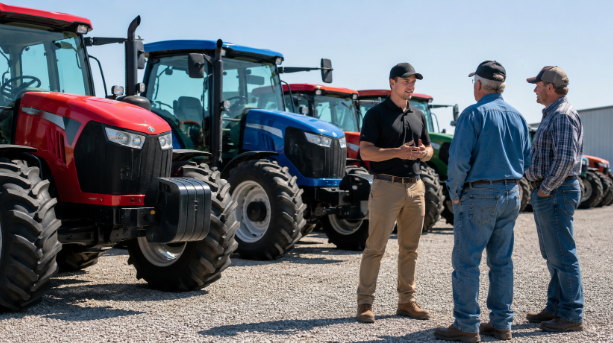
Agricultural equipment dealers play an important role between machinery suppliers and the farmers who use tractors every day. A successful tractor range should not simply contain the most powerful or expensive models available. Dealers need to understand local farm sizes, common crops, terrain, working conditions, budgets, and implement requirements so they can offer machines that solve real agricultural problems.
For dealers, distributors, and equipment businesses, selecting a dependable agriculture equipment manufacturer can be an important part of building a tractor range that serves different customer groups. The right supplier relationship can make it easier to offer suitable power levels and configurations while allowing buyers to match machinery more closely with the farming conditions found in their local market.
Start by Understanding Local Farming Conditions
Before deciding which tractors to stock, dealers should understand how agriculture works in the areas they serve.
A region dominated by small family farms may need very different machinery from an area with large commercial fields. Orchard farming, livestock operations, vegetable production, and broad-acre cropping can also create different equipment requirements.
Dealers should consider factors such as:
- Average farm size
- Main crops
- Soil type
- Terrain
- Typical implements
- Seasonal workloads
- Transport distances
- Customer budgets
This information provides a more useful starting point than simply choosing models according to popularity in another country or region.
Different Customers Need Different Power Levels
One tractor cannot meet every agricultural requirement.
Small farms may need compact machines for cultivation, mowing, light transport, or work in narrow spaces. Medium-sized farms may need tractors capable of handling a wider range of implements and longer operating hours.
Larger agricultural businesses often require more power for heavy tillage, wider equipment, and extensive fieldwork.
Dealers can serve customers more effectively by building a range that includes several practical power categories.
The objective should not be to offer as many models as possible. A carefully selected range that covers common customer requirements can be easier to explain, stock, service, and support.
Compact Tractors Can Serve Important Market Segments
Compact tractors are sometimes overlooked when dealers focus on larger farming machines.
However, smaller tractors can serve many useful markets.
They may be suitable for orchards, greenhouses, smaller fields, livestock properties, landscaping businesses, and general land maintenance.
Their smaller dimensions can make them easier to operate in places where large tractors would be inconvenient.
Dealers should understand the specific jobs compact tractor customers want to complete.
Horsepower alone does not determine whether a machine is suitable. Turning space, ground clearance, implement compatibility, and ease of operation can all influence the buying decision.
Medium Tractors Often Need Broad Versatility
Medium-power tractors may appeal to customers who want one main machine for several farm activities.
These users may need to prepare fields, operate implements, pull trailers, mow land, and complete general agricultural work throughout the year.
For this market, versatility can be more important than maximum power.
Dealers should look at whether a tractor can work with commonly used local implements and whether its hydraulic, transmission, and connection systems suit typical customer needs.
A tractor that performs several common jobs may provide stronger value for farmers who cannot justify owning several specialized machines.
Understanding these practical requirements helps dealers recommend machinery more confidently.
Larger Farms Require a Different Sales Approach
Commercial farms often evaluate tractors differently from smaller operators.
Their machines may work for longer hours, cover larger areas, and operate heavier implements.
Downtime can also become more costly because delays may affect hundreds of acres of scheduled work.
These buyers may pay closer attention to power, durability, operator comfort, maintenance requirements, fuel use, and parts support.
Dealers serving larger farms should be prepared to discuss total operating needs rather than only purchase price.
A customer investing in a higher-power tractor usually wants to know whether the machine can become a reliable part of a larger equipment system.
Implement Compatibility Can Influence Tractor Demand
Farmers rarely purchase tractors simply to drive them around the property.
The machine normally needs to operate one or more implements.
These may include:
- Plows
- Cultivators
- Rotary tillers
- Seeders
- Mowers
- Sprayers
- Loaders
- Trailers
Dealers should understand which attachments are commonly used in their market.
A tractor may have suitable engine power but still fail to meet customer expectations if hydraulic capacity, PTO requirements, connection points, or physical dimensions do not match local implements.
Selling a tractor without considering its attachments can create customer dissatisfaction later.
Build the Product Range Around Real Applications
A useful tractor catalog should be easy for customers to understand.
Instead of presenting machines only by horsepower, dealers can think about the types of jobs each model is intended to support.
For example, some tractors may be best suited to smaller properties and light fieldwork, while others may be positioned for mixed farming, heavy cultivation, or larger commercial operations.
When working with an agriculture equipment manufacturer, dealers can consider how available tractor configurations fit the applications most common in their local market. Selecting machines around practical use cases can make customer recommendations clearer and reduce the risk of stocking models that do not match regional demand.
Local Terrain Should Influence Model Selection
The physical landscape can have a major effect on tractor requirements.
Flat, open farmland may allow larger machinery to operate comfortably. Hilly regions, narrow fields, orchards, or farms with uneven access routes may require more maneuverable equipment.
Wet or loose ground can also increase the importance of traction and suitable tire options.
Dealers should avoid assuming that the same tractor configuration will perform equally well everywhere.
Talking directly with farmers can reveal problems that may not be obvious from product specifications alone.
This local knowledge can become one of the dealer’s strongest advantages when recommending machinery.
Customer Budgets Need More Than One Option
Price is an important factor in agricultural equipment purchasing.
Not every farmer has the same budget, even when their work requirements are similar.
Dealers may benefit from offering practical choices across different power levels and configurations instead of pushing every customer toward the most expensive model.
The goal should be to identify the minimum machine capability needed to perform the job reliably.
Customers often appreciate clear explanations of why one tractor may be more suitable than another.
A recommendation based on actual workload can build more trust than a sales approach focused only on larger specifications.
Tractor Configuration Can Matter as Much as Horsepower
Two tractors with similar engine power may still suit different customers.
Transmission type, drive configuration, hydraulic capability, tires, cabin options, ground clearance, and other features can affect how a machine performs.
Dealers should therefore learn enough about each model to explain these differences in practical language.
Farmers usually want to understand how a feature will affect their work.
For example, a particular transmission may be useful where frequent speed changes are required, while another setup may suit long periods of steady field operation.
Turning specifications into practical benefits makes equipment easier for customers to compare.
Parts Planning Should Begin Before Sales Increase
Selling tractors creates a long-term relationship with customers.
After the purchase, owners may need filters, seals, belts, electrical components, hydraulic parts, and other service items.
Dealers should think about parts availability before building a large installed base of machines.
Frequently used maintenance items can be identified and stocked according to expected demand.
Clear parts records can also reduce confusion when several tractor models are sold.
Customers are more likely to remain satisfied when routine service does not become difficult because a basic component cannot be identified or obtained.
Technical Knowledge Strengthens Customer Support
A dealer does not need every salesperson to be a mechanic, but basic technical knowledge is extremely useful.
Sales staff should understand important tractor specifications and know how they relate to farming tasks.
Service staff should have access to appropriate information for maintenance and troubleshooting.
This knowledge can improve communication with customers.
Instead of simply saying that one tractor has more power, a dealer can explain why that power level may be useful for a particular implement or farm size.
Good technical communication helps customers make more informed decisions and can reduce misunderstandings after purchase.
Demonstrations Can Help Customers Choose More Confidently
Agricultural machinery can be difficult to evaluate from photographs or specification sheets alone.
Where practical, demonstrations can help farmers understand how a tractor feels and operates.
Customers may want to evaluate visibility, controls, steering, seat comfort, maneuverability, and implement connection.
A demonstration can also help dealers identify concerns before the sale is completed.
For example, a customer may realize that a larger tractor is difficult to use in a narrow farm environment.
Seeing the equipment in operation can make purchasing decisions more practical and reduce the chance of choosing based only on numbers.
Avoid Stocking Models Without Clear Market Demand
A large product range may look impressive, but it can create inventory problems if many models have little local demand.
Dealers should review which tractor categories customers actually request.
Sales inquiries, farm visits, seasonal demand, and previous purchases can all provide useful information.
It may be better to focus on a smaller number of well-matched models and understand them thoroughly.
Additional configurations can then be introduced when there is evidence of demand.
This approach can reduce unnecessary inventory while still allowing the business to expand its tractor range gradually.
Customer Feedback Can Improve Future Purchasing Decisions
Farmers who use machinery every day can provide valuable information.
Dealers should pay attention to comments about performance, comfort, maintenance, implement compatibility, and operating conditions.
Repeated feedback may reveal that customers need a different tire option, power range, configuration, or attachment solution.
This information can guide future inventory decisions.
Customer feedback also helps dealers understand how machinery performs outside controlled conditions.
A tractor that looks suitable on paper may reveal different strengths or limitations after hundreds of hours of real farm use.
Think Beyond the Initial Tractor Sale
A strong agricultural equipment business is not built only on individual transactions.
Farmers may return for replacement parts, servicing, additional implements, another tractor, or equipment for an expanding operation.
Providing accurate recommendations can therefore have long-term value.
Selling an unsuitable tractor may create a quick transaction but damage customer confidence later.
Dealers should aim to understand what the farmer is trying to accomplish and recommend machinery accordingly.
A customer who feels that equipment was selected around genuine needs is more likely to maintain a positive relationship with the supplier.
Conclusion
Choosing a tractor range for a local agricultural market requires more than comparing horsepower and prices. Dealers need to understand farm sizes, crops, terrain, implements, budgets, operator requirements, maintenance expectations, and the different workloads customers face throughout the year.
A carefully planned range can make it easier to serve compact farms, medium agricultural operations, and larger commercial customers without carrying unnecessary inventory. Parts planning, technical knowledge, customer demonstrations, and feedback can further improve the value a dealer provides after the initial sale. Agricultural dealers, distributors, and farming businesses looking to evaluate tractor options for different market requirements can find additional product information through Gengjiaagri.com.