
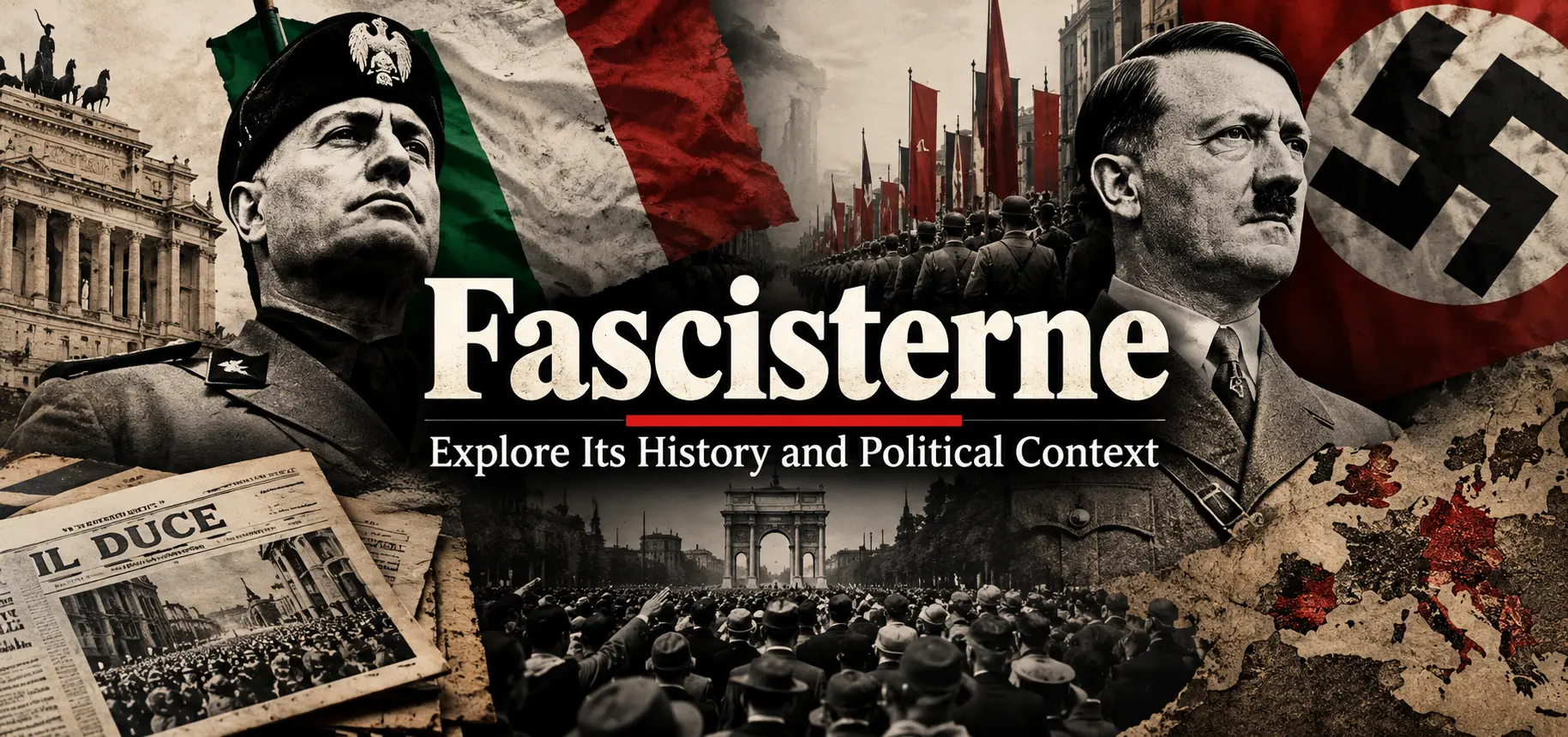
The Danish word Fascisterne translates most directly into English as “the fascists.” While the word itself is simple, its historical meaning connects to one of the most significant political developments of modern European history. Understanding Fascisterne requires looking beyond the translation and examining the rise of fascism, its relationship with nationalism and authoritarian politics, and the way related movements developed in countries such as Denmark.
Fascism emerged as a powerful political force in Europe after the First World War. It became particularly associated with Benito Mussolini's movement in Italy, while other nationalist, authoritarian, and anti-democratic movements appeared across Europe. In Denmark, the historical discussion often includes the Danmarks Nationalsocialistiske Arbejderparti (DNSAP), a Nazi movement founded in 1930 and strongly influenced by Germany's NSDAP.
This article explores Fascisterne, its linguistic meaning, historical background, political context, Danish connection, and continuing importance in historical discussions.
Fascisterne and Its Meaning in Danish
Fascisterne is the definite plural form of the Danish noun fascist. In straightforward English, it means “the fascists.” It refers to people rather than the ideology itself.
A useful distinction is:
- Fascist – a person associated with fascism.
- Fascister – fascists.
- Fascisterne – the fascists.
- Fascisme – fascism, the political ideology or movement.
This grammatical distinction matters because Fascisterne is not the formal name of a single political organization. Depending on the surrounding text, it can refer to Italian fascists, Danish fascists, or people associated with other fascist movements.
The historical context therefore determines exactly whom the word describes.
How Fascisterne Connects to Fascism
The origins of modern fascism are generally associated with Italy after the First World War. Benito Mussolini became the central figure in the development of Italian Fascism, which developed during a period marked by political instability, social conflict, economic uncertainty, and fears about revolutionary movements.
Fascist movements rejected important elements of liberal parliamentary politics and promoted strong national unity, discipline, authority, and political mobilization. Although movements described as fascist differed between countries, several recurring characteristics appeared in historical examples.
- Strong or authoritarian leadership
- Intense nationalism
- Opposition to liberal democratic institutions
- Political mobilization and mass organizations
- Propaganda and controlled political messaging
- Suppression of political opponents
- Glorification of national strength and unity
Not every authoritarian or nationalist movement should automatically be classified as fascist. Historians distinguish between different political systems and movements according to their ideology, organization, objectives, and historical circumstances.
Fascisterne in the European Historical Context
The development of fascism cannot be separated from the difficult political environment of Europe following World War I. Several countries experienced economic disruption, social tensions, political violence, and dissatisfaction with established political institutions.
Fascist organizations presented themselves as movements capable of restoring order and national strength. Their political messaging often emphasized unity over political disagreement and portrayed opponents as threats to the nation.
The Italian experience under Mussolini became an important model for fascist movements elsewhere. However, European movements did not simply reproduce one identical political system. Their programs reflected local political cultures, national conflicts, religious traditions, economic conditions, and relationships with Germany and Italy.
This is especially important when discussing Fascisterne in relation to Denmark.
The Danish Connection to Fascisterne
Denmark had several small right-wing radical and fascist-influenced groups during the interwar period. The most historically significant organization associated with Danish Nazism was the Danmarks Nationalsocialistiske Arbejderparti (DNSAP).
DNSAP was founded on November 16, 1930, with Cay Lembcke as its first leader. The organization was strongly inspired by Adolf Hitler's German Nazi Party. According to Denmark's historical encyclopedia, its program, political symbolism, rhetoric, and organization closely followed the German model, including antisemitism, nationalism, and opposition to parliamentary democracy.
This makes DNSAP particularly relevant when examining the Danish historical context surrounding Fascisterne.
Frits Clausen and the Growth of DNSAP
In 1933, Frits Clausen became the leader of DNSAP. Under his leadership, the organization developed a more structured political and organizational presence.
The party created publications, youth organizations, and other groups influenced by the organizational style of German National Socialism. Its membership increased during the 1930s, although its electoral influence remained limited.
The movement therefore demonstrates an important distinction between organizational strength and electoral popularity. A political group can have committed members and active institutions without becoming a dominant electoral force.
Fascisterne and Danish Elections
DNSAP participated in Danish parliamentary politics, but it never achieved a dominant position.
The party's electoral record provides useful historical evidence:
| Year | Political Context | DNSAP Result |
|---|---|---|
| 1930 | Party founded | New political movement |
| 1933 | Frits Clausen became leader | Organizational development |
| 1939 | Parliamentary election | 1.8% of votes and 3 seats |
| 1940 | German occupation of Denmark | Party operated under occupation |
| 1943 | Parliamentary election | About 2.1% of votes and 3 seats |
| 1945 | End of German occupation | DNSAP dissolved |
At the 1939 election, DNSAP received 1.8% of the vote and won three seats in the Folketing. Even in 1943, during the German occupation, it received only about 2.1% and again won three seats. Denmark's historical encyclopedia describes the organization as remaining a marginal political phenomenon despite its substantial membership and activity.
These figures are important because they provide historical context without assuming that the existence of a fascist or Nazi organization represented the political preferences of Danish society as a whole.
The Impact of German Occupation
Germany occupied Denmark beginning in April 1940. The occupation dramatically changed the political environment in which Danish Nazi organizations operated.
DNSAP supported the German invasion and occupation. However, German authorities did not immediately replace Denmark's existing political system with a DNSAP-led government. The relationship between the Danish Nazi movement and the German occupation authorities was complicated by Germany's broader strategy toward Denmark.
This period demonstrates why the word Fascisterne must be interpreted within its historical setting. Danish fascist and Nazi movements existed before occupation, but occupation transformed their political circumstances and created new relationships between domestic organizations and German power.
Fascist Ideas and Political Organization
Historical fascist movements often attempted to create more than ordinary political parties. They sought to influence social life, culture, youth organizations, communication, and public behavior.
Several recurring methods can be seen across historical fascist movements:
- Political propaganda: Messages were designed to create loyalty toward the movement and its leadership.
- Mass organization: Supporters were organized through parties, youth groups, associations, publications, and public demonstrations.
- National symbolism: Flags, uniforms, slogans, ceremonies, and other symbols helped create a shared political identity.
- Opposition to pluralism: Political disagreement was frequently portrayed as weakness or as a threat to national unity.
- Centralized leadership: Authority was concentrated around leaders and party structures rather than distributed through competitive institutions.
DNSAP adopted several organizational and symbolic elements inspired by German National Socialism, including publications and youth organizations modeled partly on developments in Germany.
Fascisterne, Fascism, and Nazism Are Not Identical Terms
One of the most important points when researching Fascisterne is the distinction between fascism and Nazism.
Fascism is a broader historical category associated most famously with Mussolini's Italy. Nazism developed in Germany under Adolf Hitler and shared several characteristics with fascism, including authoritarian leadership, extreme nationalism, anti-democratic politics, propaganda, and political repression.
However, Nazism had distinctive features, particularly its racial ideology, antisemitism, and conceptions of biological hierarchy.
The Danish DNSAP was specifically a National Socialist organization and was heavily influenced by Hitler's German NSDAP. Denmark's historical scholarship therefore commonly discusses it within the history of Danish Nazism rather than treating it as simply another generic fascist party.
Understanding these distinctions makes historical writing more precise.
Why Fascisterne Remains a Significant Historical Term
The term remains relevant because fascism changed European politics profoundly during the twentieth century. Its history is connected with dictatorship, political repression, war, propaganda, persecution, and the destruction of democratic institutions in countries where fascist or closely related movements obtained state power.
For Denmark, the subject also helps explain the country's experience during the German occupation and the political choices made by different organizations and individuals.
Studying Fascisterne therefore involves more than learning a Danish translation. It opens a wider examination of:
- European political history
- Interwar nationalism
- Authoritarian movements
- Danish Nazism
- World War II and occupation
- Political propaganda
- The relationship between movements and democratic institutions
Historical Lessons From the Fascisterne Era
The history of fascist movements offers several important lessons for understanding political systems.
First, democratic institutions can face pressure during periods of crisis. Economic hardship, political polarization, social anxiety, and fears about instability can create opportunities for movements promising dramatic solutions.
Second, propaganda can shape political identities by presenting complex problems through emotionally powerful narratives.
Third, political movements often adapt ideas to local circumstances. Danish Nazism, for example, was heavily influenced by Germany while simultaneously attempting to present itself through Danish nationalism. This created a fundamental tension within DNSAP's political identity.
Finally, historical terminology matters. Using terms such as fascism, Nazism, authoritarianism, and nationalism accurately helps readers understand differences rather than treating every political movement as identical.
Fascisterne in Modern Historical Discussions
Today, Fascisterne may appear in Danish historical writing, discussions of World War II, academic research, political commentary, or translations from Danish-language sources.
The meaning still depends on context. A historian discussing Mussolini's Italy may use the term to describe Italian fascists. A Danish history text discussing the 1930s and 1940s might use it in connection with Danish fascist or Nazi groups.
The word should therefore not automatically be interpreted as the name of a specific party or organization.
This contextual approach is especially useful for readers encountering Danish historical terminology through search engines or translated material.
Final Thoughts
Fascisterne is a Danish word that simply translates as “the fascists,” but its historical associations are much broader. Understanding it requires knowledge of the development of fascism in Europe, the rise of Mussolini, the spread of related authoritarian movements, and the particular development of Danish Nazism.
In Denmark, DNSAP became the most important Nazi organization of the interwar and occupation period. Founded in 1930 and later led by Frits Clausen, it closely followed the political and organizational example of Hitler's German movement. Yet its electoral support remained limited, reaching 1.8% in 1939 and about 2.1% in 1943.
The history surrounding Fascisterne is therefore both complex and powerful. It shows how political ideas cross national borders, how movements adapt foreign models to local conditions, and how historical context is essential when interpreting political language.
FAQs About Fascisterne
What does Fascisterne mean?
Fascisterne is a Danish word meaning “the fascists.”
Is Fascisterne the name of a political party?
No. It is the definite plural form of fascist and does not itself identify one specific political organization.
What is the Danish connection to fascism?
Denmark had several fascist-influenced groups, while DNSAP became the country's most significant Nazi organization during the 1930s and World War II period.
Who led DNSAP?
Cay Lembcke initially led DNSAP. Frits Clausen became its leader in 1933 and remained associated with the organization through the occupation period.
Why is Fascisterne historically important?
The term provides an entry point into the history of fascism, Nazism, Danish political movements, German occupation, and the broader political conflicts of twentieth-century Europe.