
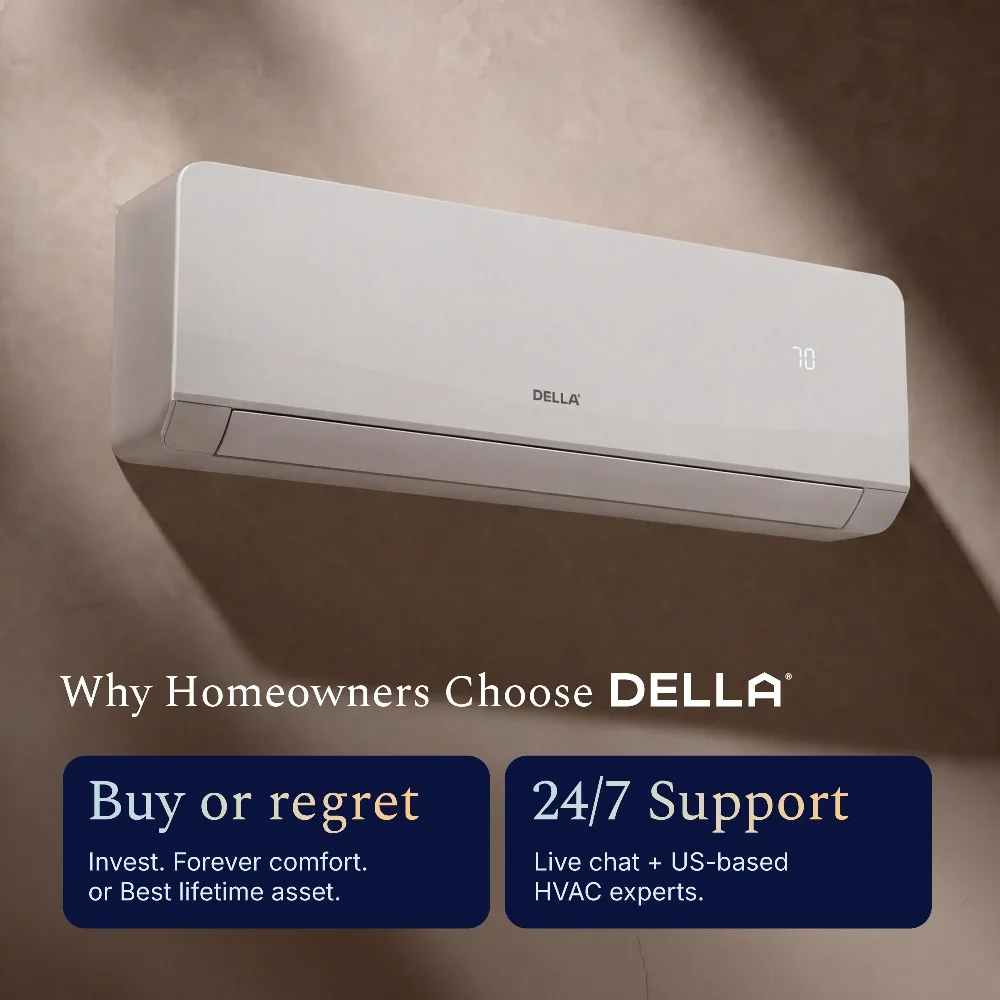
A DELLA 18000 BTU mini split system can be a practical option for many two-car garages, but garage size alone cannot determine whether 18,000 BTU is enough. Unlike a typical bedroom or living room, a garage often has large exterior doors, more air leakage, unfinished walls, and greater temperature swings. Those conditions can place much more demand on a mini split ac.
Before choosing the system, look at both the garage dimensions and the features that affect how quickly it gains or loses heat.
Two-Car Garage Size Is Only the Starting Point
Many two-car garages fall somewhere around 400 to 600 square feet, although layouts vary widely. Based strictly on floor area, an 18,000 BTU system may appear more than adequate for many of them.
However, residential BTU-to-square-foot estimates assume relatively normal indoor construction. Garages often do not meet those assumptions.
A 500-square-foot insulated garage with finished walls may be easier to condition than a 400-square-foot detached garage with exposed framing and frequent air leakage. That is why floor area should begin the calculation rather than end it.
Insulation Makes a Major Difference in Capacity Needs
An insulated garage holds conditioned air much more effectively. Insulation in the ceiling, exterior walls, and garage door can reduce summer heat gain and winter heat loss.
An unfinished garage may allow heat to pass quickly through the roof and wall assemblies. In that situation, the system must run longer to maintain the same indoor temperature.
Air sealing matters too. Gaps around windows, doors, and wall penetrations can allow outdoor air to enter continuously. Improving the building envelope before installing HVAC can sometimes make a bigger difference than simply moving to a larger unit.
Garage Doors and Sun Exposure Increase the Load
The garage door is often the largest source of heat transfer. A wide, uninsulated metal door exposed to afternoon sunlight can become extremely warm and transfer that heat indoors.
Opening the door also replaces much of the conditioned air with outdoor air in a short period. If vehicles enter and leave several times per day, the cooling system must repeatedly recover from those temperature changes.
Roof orientation and shade matter as well. A detached garage sitting in full sun throughout the afternoon may experience far greater cooling demand than a shaded garage attached to the north side of a house.
Climate and Daily Use Affect Heating and Cooling Demand
How you use the garage changes the capacity you need.
Someone who occasionally works in the garage for an hour or two may not require the same level of temperature control as someone using it as a workshop, gym, hobby room, or office every day.
Climate adds another layer. In a mild region, the system may mainly handle moderate summer cooling. In areas with very hot summers or cold winters, the peak load can be considerably higher.
If heating is important, check low-temperature performance as well as nominal BTU capacity. The heating output available during cold weather is more relevant than the headline rating alone.
When an 18000 BTU System Makes Sense for a Garage
An 18,000 BTU system is most promising for a two-car garage that has already been reasonably insulated and air sealed.
It can be particularly appropriate when:
Garages with tall ceilings, poor insulation, heavy afternoon exposure, or frequently opened doors may require a different capacity assessment.
Rather than assuming every two-car garage needs the same equipment, calculate the actual heating and cooling load. That gives an 18,000 BTU system a much better chance of delivering the comfort you expect.