
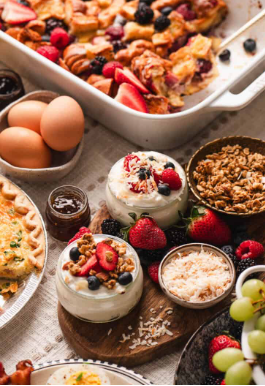
Brunch is the most forgiving meal to host and the easiest one to over-complicate. The trap is treating it like a scaled-down dinner party. Multiple hot dishes, everything finishing at once, the host stuck at the stove while guests stand around holding coffee.
Quiche solves most of that. It’s the rare dish that’s genuinely good warm or at room temperature, slices cleanly for a crowd, and can be finished before anyone arrives. Build the menu around it and the rest of the planning falls into place quickly.
Here’s how to do it.
Why Quiche Anchors a Brunch Table
Three properties make quiche unusually well suited to entertaining.
It holds. Most brunch food degrades on a table. Eggs go rubbery, pancakes go cold and sad. A quiche sits comfortably for an hour at room temperature and arguably tastes better than it does straight from the oven, once the custard has settled.
It portions predictably. You know exactly how many slices you have. That’s not true of a frittata scooped from a pan or scrambled eggs from a chafing dish, where the first three guests take twice their share.
It reads as a real dish. A table of pastries and fruit feels like a coffee break. One savory centerpiece makes it a meal, and guests stop hovering because they know what the substantial thing is.
How Much to Plan For
Start with headcount and work backward.
A standard tart typically yields six to eight slices. If quiche is the centerpiece and there are two or three substantial sides, plan roughly one slice per person plus 20 percent. If it’s part of a larger spread with other hot dishes, three-quarters of a slice per person is closer to right.
For groups over ten, two smaller quiches beat one large one. You get two flavors, two serving points so the line moves, and the option to hold the second in the oven while the first is being eaten.
Individual portions are worth considering for seated brunches or when guests are eating in shifts. They cost more per serving but eliminate slicing entirely.
Choosing the Flavors
For a single quiche, go classic. Lorraine or a spinach-and-cheese version will satisfy essentially everyone, including guests you don’t know well.
For two, use contrast rather than variety for its own sake. Pair one meat-based option with one vegetable-based option. That covers the vegetarian at the table without making a production of it, and it gives guests a reason to take a sliver of each.
For three or more, add a specialty as the third: smoked salmon, leek and goat cheese, roasted pepper. Specialty flavors are the ones people talk about, but they shouldn’t be the only option available.
One practical note: check for dietary restrictions before you finalize, not after. Retrofitting a vegetarian option into a finished menu is harder than planning one in from the start.
Sourcing Without a Two-Hour Project
Making quiche properly means blind-baking a shell, cooking down the filling, and nursing a custard to the right set. That’s a serious morning of work on a day when you also have a house to prepare.
Buying it back is a reasonable trade. Local bakeries and specialty markets are the obvious first stop, though selection tends to be inconsistent and you’re at the mercy of what they baked that morning. Hosts researching where to buy quiche for a specific date often find that specialty producers offer more range in flavor and format than a local counter, which matters when you’re trying to cover several preferences at once.
Whatever the source, look for a clear ingredient list, stated weight and diameter rather than just a serving estimate, and photographs of an actual sliced product so you can see the custard-to-filling ratio.
Sides That Do the Most Work
The supporting cast should be things that require no cooking on the day.
A sharp green salad. Quiche is rich, and acid resets the palate between bites. Dress it at the last second so it doesn’t wilt.
Fresh fruit. Cut the night before, keep it covered. Cheap, colorful, and the thing that photographs well.
Bread and butter. A baguette and good butter. Nobody has ever complained.
Something pickled. Cornichons, quick-pickled onions, olives. Contrast again.
One sweet item. A single pastry or a simple cake. One is enough. This is brunch, not a bakery display.
That’s five items, four of which are assembled rather than cooked. The only thing needing heat is the quiche itself.
The Timing Plan
Work backward from when guests arrive.
Night before: cut fruit, wash and dry greens, make the vinaigrette, set out platters and serving utensils.
Ninety minutes ahead: take the quiche out of the refrigerator if it’s already baked, so it isn’t fridge-cold going into the oven.
Forty minutes ahead: oven to 325 to 350°F, quiche in. Tent with foil if the crust rim is browning fast.
Fifteen minutes ahead: quiche out, resting. Set out fruit, bread, pickles.
Five minutes ahead: dress the salad. Coffee on.
The quiche rests while guests arrive and get drinks, which is exactly the buffer you want. Slice it in front of people, since it looks better and it’s warmer.
Serving and Layout
Slice with a sharp thin-bladed knife, wiping between cuts. Serve on a board or the tart pan base rather than transferring slices to a platter, which breaks them.
Lay the table so the quiche is the first thing people reach, then salad, then everything else. Guests build plates around the anchor dish rather than filling up on pastries and skipping the main item.
Room temperature is fine. Genuinely fine. Don’t hover over it with foil trying to keep it hot.
Making It Repeatable
The real advantage of this menu shows up the second and third time you use it. Once you know your household’s slice count and which sides your friends actually eat, brunch becomes a fifteen-minute decision.
Being able to buy quiche online in advance makes that repeatability practical. You can keep one in the freezer and go from an unplanned Sunday invitation to a real brunch table with an hour’s notice. Check the producer’s storage guidance and reheating instructions when it arrives, and follow theirs over any general rule of thumb.
Leftovers
Wrap leftover slices individually and refrigerate. They keep a few days and reheat well in a moderate oven. The same method that revived the whole tart works on a single slice, just faster.
Cold quiche with a handful of greens is also a respectable lunch, which is more than can be said for leftover pancakes.