
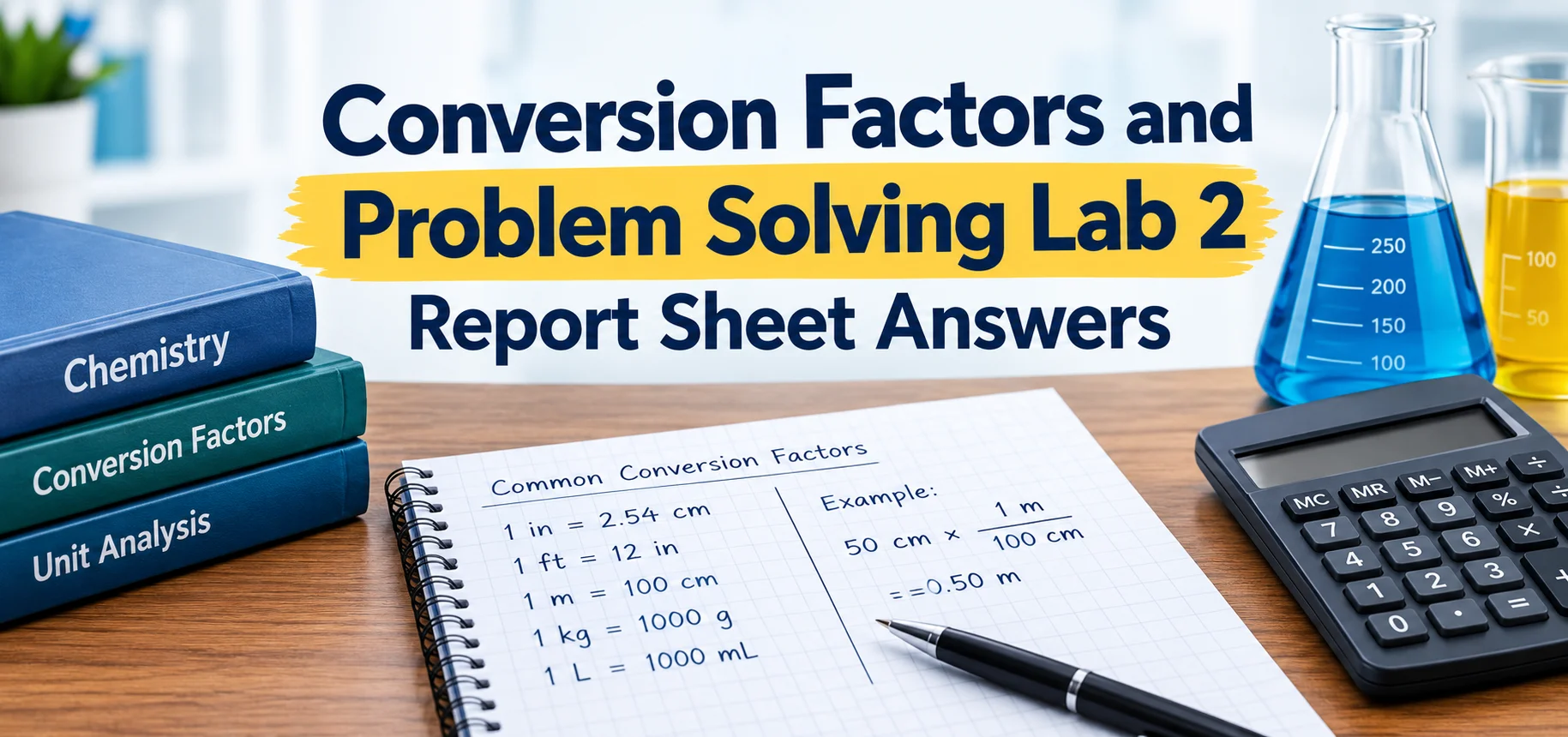
Finding accurate Conversion Factors and Problem Solving Lab 2 Report Sheet Answers can make a laboratory assignment much easier to understand, especially when the worksheet involves unit conversions, dimensional analysis, significant figures, and multi-step calculations. However, the most useful approach is not simply copying an answer. Students should understand how each answer is produced so they can confidently solve similar problems on quizzes, exams, and future laboratory activities.
Conversion-factor problems are common in introductory chemistry and science courses because they teach a practical method for moving between different units. Lab 2 often combines these calculations with real measurements, requiring students to organize information carefully and report results using appropriate units and precision.
This guide explains the main problem-solving techniques, common calculations, answer-checking methods, and mistakes students should avoid when working with Conversion Factors and Problem Solving Lab 2 Report Sheet Answers.
Understanding Conversion Factors in Lab 2
A conversion factor is a ratio that relates two equivalent quantities expressed in different units. Because the numerator and denominator represent the same amount, the ratio can be used to change a measurement from one unit to another without changing its actual value.
For example:
1 meter = 100 centimeters
From this relationship, two conversion factors can be created:
- 1 m / 100 cm
- 100 cm / 1 m
The correct version depends on the unit you want to eliminate.
This is the foundation of dimensional analysis. Instead of guessing whether to multiply or divide, you arrange the conversion factor so the unwanted unit cancels.
Why Unit Cancellation Matters
Unit cancellation is one of the most powerful ways to check a calculation. Suppose you need to convert 250 centimeters into meters:
250 cm × (1 m / 100 cm) = 2.50 m
The centimeters cancel, leaving meters. If the unwanted unit does not cancel, the conversion factor has probably been placed incorrectly.
When reviewing Conversion Factors and Problem Solving Lab 2 Report Sheet Answers, always examine the units before checking the numerical answer.
How to Solve Conversion Problems Step by Step
A reliable method can prevent many calculation errors. Whether the question involves length, mass, volume, time, or another measurement, use the same basic process.
Step 1: Identify the Given Measurement
Start by writing down the number and its unit.
For example:
Given = 5.0 kilometers
Do not remove the unit from the calculation. The unit is an essential part of the information.
Step 2: Identify the Desired Unit
Determine exactly what the question wants.
If the problem asks for meters, your final expression should end in meters.
Step 3: Select the Correct Conversion Factor
Use a known equality.
For example:
1 km = 1,000 m
To convert kilometers to meters:
5.0 km × (1,000 m / 1 km)
Step 4: Cancel the Original Unit
The km units cancel:
5.0 km × (1,000 m / 1 km)
This leaves meters.
Step 5: Calculate and Report the Answer
5.0 × 1,000 = 5,000 m
The final answer should include the correct unit and, where appropriate, the correct significant figures.
Conversion Factors and Problem Solving Lab 2 Report Sheet Answers: Common Examples
Lab report sheets frequently include several types of conversions. Although the exact questions may vary by course or instructor, the underlying method remains consistent.
| Conversion Type | Example Relationship | Example Conversion |
|---|---|---|
| Length | 1 m = 100 cm | 3 m = 300 cm |
| Mass | 1 kg = 1,000 g | 2.5 kg = 2,500 g |
| Volume | 1 L = 1,000 mL | 4 L = 4,000 mL |
| Time | 1 min = 60 s | 5 min = 300 s |
| Distance | 1 km = 1,000 m | 2.4 km = 2,400 m |
These examples demonstrate the basic structure students can use when completing a report sheet. For actual assigned questions, the given conversion relationship and requested units should always be followed.
Using Dimensional Analysis Correctly
Dimensional analysis is especially useful when a problem requires more than one conversion.
Imagine a measurement given in kilometers per hour that needs to be converted to meters per second. You cannot simply convert the numerator and ignore the denominator. Both units must be handled.
A general setup looks like this:
km/h × m/km × h/s
The kilometers and hours cancel, leaving meters per second.
Why This Method Is Reliable
Dimensional analysis creates a logical chain. Each conversion factor is selected because it removes one unwanted unit and introduces the next required unit.
This makes complicated calculations easier to inspect and significantly reduces careless mistakes.
When reviewing your Lab 2 answers, ask:
- Did I write the original value correctly?
- Did I choose an equivalent conversion factor?
- Did the unwanted units cancel?
- Is the final unit correct?
- Does the numerical result make sense?
Significant Figures in Lab Calculations
Significant figures are another important part of many laboratory report sheets. The final answer should reflect the precision of the measurements provided.
For multiplication and division, the result generally follows the number with the fewest significant figures.
For example:
2.5 × 3.42 = 8.55
Because 2.5 contains two significant figures, the result should normally be reported as:
8.6
Students sometimes lose marks even when their calculation is mathematically correct because the reported precision does not match the original data.
Exact Conversion Factors
Some conversion relationships are treated as exact, particularly definitions such as:
1 minute = 60 seconds
Exact relationships do not normally limit significant figures in the same way measured quantities do.
However, follow the specific rules provided by your instructor or laboratory manual if they differ.
Common Mistakes When Completing Lab 2
Many incorrect answers come from simple setup problems rather than difficult mathematics.
Watch for these frequent errors:
- Reversing the conversion factor: Putting the desired unit in the denominator can prevent cancellation.
- Forgetting units: A number without a unit may be incomplete or misleading.
- Using the wrong relationship: Make sure both sides of the conversion factor are equivalent.
- Rounding too early: Keep additional digits during intermediate calculations and round at the end.
- Ignoring significant figures: Match the final precision to the rules required by the laboratory.
These mistakes are easy to overlook when completing a report quickly. A short verification step can catch many of them.
A Practical Strategy for Report Sheet Problems
If your Lab 2 report sheet contains multiple questions, solve them in an organized sequence rather than jumping between problems.
First, identify the known quantity. Next, write the desired unit. Then select the appropriate conversion factor and arrange it for cancellation.
For example:
Given quantity → conversion factor → unit cancellation → calculation → final answer
This structure is simple but remarkably effective.
Keep Work Visible
Showing the calculation is valuable even when the answer seems obvious. Your instructor may award points for the correct setup, unit cancellation, and reasoning.
A complete response might look like:
750 mL × (1 L / 1,000 mL) = 0.750 L
The calculation demonstrates where the result came from instead of presenting only the final number.
Checking Whether Your Answer Makes Sense
Answer verification is an essential part of laboratory problem solving.
Suppose you convert a small quantity from grams to kilograms and obtain a larger numerical value. That should immediately raise a concern because kilograms are larger units than grams.
For example:
500 g = 0.500 kg
The numerical value decreases because the unit becomes larger.
This type of estimation can provide a quick and powerful check even before you repeat the calculation.
Use Reverse Conversion
Another useful technique is to convert your result back into the original unit.
If you calculated:
2.5 kg = 2,500 g
then:
2,500 g ÷ 1,000 = 2.5 kg
The reverse calculation confirms the relationship.
How to Present Conversion Factors and Problem Solving Lab 2 Report Sheet Answers
A good report sheet should be clear, readable, and logically organized. Even when an instructor only requests numerical answers, showing enough work demonstrates understanding.
A strong answer generally includes:
- The original measurement and unit.
- The conversion factor.
- The cancellation of unwanted units.
- The calculation.
- The final answer with the correct unit.
Avoid filling the report sheet with unnecessary explanations, but do not remove important mathematical steps.
Improving Your Problem-Solving Skills
The goal of Lab 2 should be more than completing one worksheet. Conversion skills are used throughout chemistry, physics, biology, medicine, engineering, and everyday measurement.
You can improve quickly by practicing problems that involve different units.
Try working through conversions involving:
- Mass
- Length
- Volume
- Temperature
- Time
- Density
- Speed
Once the basic method becomes familiar, multi-step problems become much less intimidating.
Practice Before Checking Answers
If you have access to an answer key, use it as a verification tool rather than your first step.
Attempt each problem independently, then compare your work. If your answer differs, identify where the calculation changed rather than simply replacing your answer.
This creates a stronger understanding and helps prevent the same mistake on future assignments.
Tips for Accurate Lab Report Calculations
When working through Conversion Factors and Problem Solving Lab 2 Report Sheet Answers, a consistent routine can make your work faster and more accurate.
- Write every unit clearly instead of working with numbers alone.
- Arrange conversion factors so unwanted units cancel.
- Keep extra digits during intermediate calculations and round at the end.
- Check whether the size of the answer is reasonable before submitting it.
- Review your final units and significant figures against the instructions.
These five habits are simple, but together they create a dependable calculation process.
Why Understanding the Method Is Better Than Memorizing Answers
Laboratory assignments can contain similar-looking questions with different numbers. Memorizing a particular answer therefore provides limited value.
Understanding the conversion process gives you a reusable method.
If you know that:
1 kg = 1,000 g
you can convert 3 kg, 7.5 kg, 125 g, or virtually any other related measurement by constructing the appropriate conversion factor.
That flexibility is the real benefit of learning dimensional analysis.
Final Thoughts
Conversion Factors and Problem Solving Lab 2 Report Sheet Answers are most useful when they help students understand the reasoning behind each calculation. Conversion problems become much easier once you consistently identify the given unit, determine the desired unit, choose the correct conversion factor, cancel units, calculate carefully, and check the result.
The strongest approach is to use answer resources as a learning and verification tool rather than relying on copied results. With regular practice, dimensional analysis, significant figures, and unit conversions become straightforward skills that can support success in later science courses.
FAQs
1. What is the easiest way to solve a conversion problem?
Write the given value, choose a conversion factor, arrange it so the original unit cancels, and calculate the remaining value.
2. Why do units need to be included?
Units show what a number represents and help you determine whether the conversion has been arranged correctly.
3. What is dimensional analysis?
Dimensional analysis is a calculation method that uses conversion factors to change units while maintaining equivalent quantities.
4. Should I round during every step?
Usually, keep additional digits during intermediate calculations and round the final answer according to the required significant-figure rules.
5. Can I use an answer key for Lab 2?
Yes, an answer key can be useful for checking your work, but understanding the calculation method is more valuable than simply copying the final answers.