
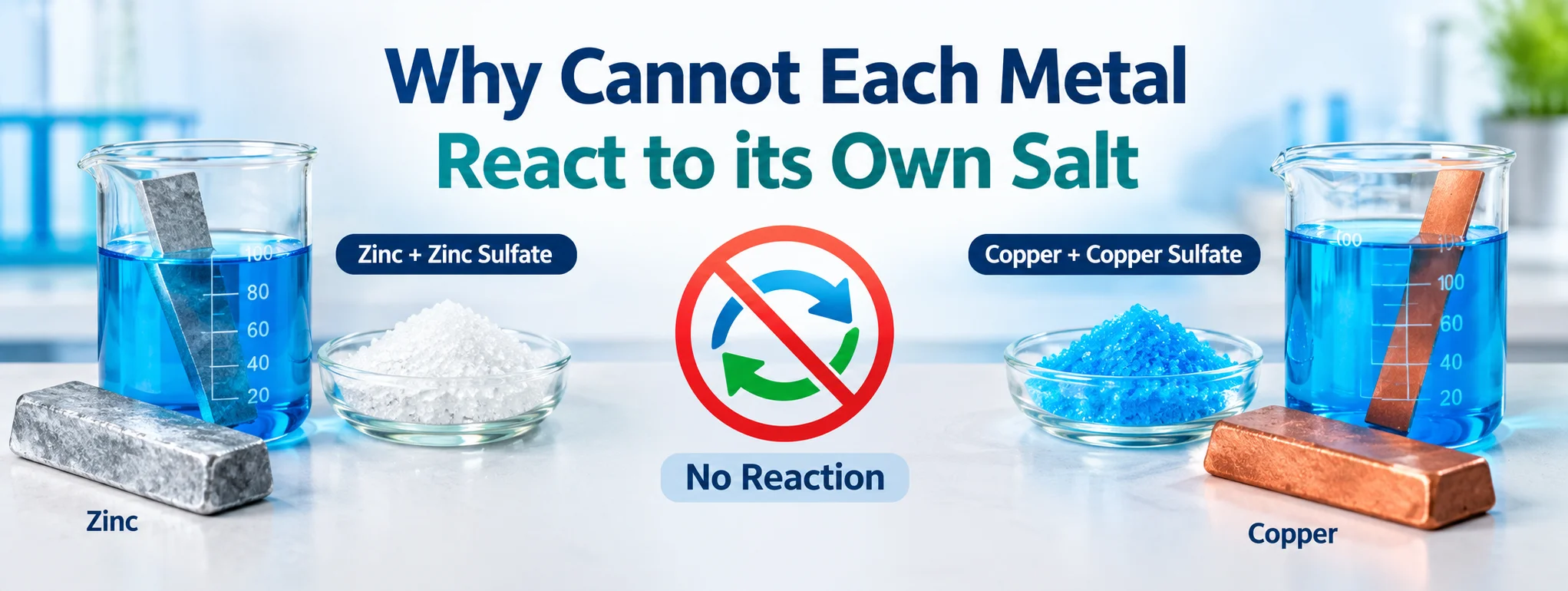
When studying chemical reactions, one common question is why a metal does not usually react with a salt made from the same metal. For example, why does copper not react with copper sulfate, or why does zinc not react with zinc sulfate? The answer becomes clear when we understand the activity series of metals, displacement reactions, and the movement of electrons.
Understanding Metal and Salt Reactions
A salt is an ionic compound formed from positive and negative ions. In a metal salt such as copper sulfate (CuSO₄), copper exists as Cu²⁺ ions while sulfate exists as SO₄²⁻ ions. When a metal is placed into a solution containing another metal’s salt, a reaction may occur if the added metal is more reactive.
This type of reaction is called a displacement reaction. The more reactive metal gives up electrons and becomes a positive ion, while the less reactive metal ions gain electrons and are deposited as metal.
For example, zinc is more reactive than copper. When zinc is placed in copper sulfate solution, zinc displaces copper:
Zn + CuSO₄ → ZnSO₄ + Cu
Zinc loses electrons and enters the solution as Zn²⁺ ions. Copper ions gain those electrons and form solid copper.
Why Does a Metal Not Displace Itself?
Consider copper metal placed in copper sulfate solution. The solution already contains Cu²⁺ ions, which are the same type of metal as the copper electrode.
For a displacement reaction to happen, the solid metal must be able to give electrons to the ions of another, less reactive metal. In the case of copper and copper ions, there is no difference in reactivity that provides a driving force for a simple displacement reaction.
The reaction would essentially be:
Cu + CuSO₄ → CuSO₄ + Cu
Nothing has actually changed. Copper atoms would become copper ions while an equal process would convert copper ions back into copper atoms. There is no overall chemical change, so we do not describe this as a displacement reaction.
The Role of the Activity Series
The activity series ranks metals according to their tendency to lose electrons and form positive ions. Metals near the top are more reactive and can generally displace metals below them from their salt solutions.
Some commonly studied metals are arranged approximately as follows:
| Metal | Relative Reactivity | Can Displace Copper? |
|---|---|---|
| Potassium | Very high | Yes |
| Calcium | Very high | Yes |
| Magnesium | High | Yes |
| Aluminium | High | Yes |
| Zinc | Moderate-high | Yes |
| Iron | Moderate | Yes |
| Copper | Low | No |
| Silver | Very low | No |
| Gold | Very low | No |
This series helps predict whether a metal can displace another metal from its salt. A metal cannot simply displace itself because it has the same position in the activity series.
Electron Transfer Explains the Process
Chemical reactions between metals and metal salts are closely related to electron transfer. A reactive metal tends to lose electrons easily.
For example:
Zn → Zn²⁺ + 2e⁻
The electrons released by zinc can be accepted by copper ions:
Cu²⁺ + 2e⁻ → Cu
When these two half-reactions occur together, zinc replaces copper in the salt solution.
However, when copper metal is placed in copper sulfate, there is no useful electron-transfer difference between the copper atoms and copper ions. Both belong to the same metal system. The reaction has no net chemical change under ordinary conditions.
Why Reactivity Differences Matter
The key factor is not simply whether a metal is placed in a salt solution. The important question is whether the metal being added is more reactive than the metal present in the salt.
For example, iron can react with copper sulfate because iron is more reactive than copper:
Fe + CuSO₄ → FeSO₄ + Cu
But copper does not displace iron from iron sulfate:
Cu + FeSO₄ → No reaction
Copper is less reactive than iron, so it cannot easily provide the electrons needed to convert Fe²⁺ ions into iron metal.
When the same metal is involved on both sides, there is also no reactivity advantage. This is why a metal generally does not react with its own salt through an ordinary displacement reaction.
Are There Any Exceptions?
It is important not to interpret this rule as saying that a metal can never undergo any chemical reaction in a solution containing its own salt. Electrochemical systems can involve oxidation and reduction processes, especially when an external electrical source, concentration difference, or other chemical conditions are present.
For example, electroplating uses an external power supply to force metal ions to become solid metal. These processes are different from a simple metal-displacement reaction and should not be confused with the ordinary reaction between a metal and another metal’s salt.
Everyday and Laboratory Importance
Understanding this principle is useful in chemistry laboratories and industrial processes. The activity series helps scientists predict which metals can be recovered from solutions, which metals may corrode, and which combinations can produce useful displacement reactions.
It also explains why certain metals can be used to extract other metals from their compounds. A sufficiently reactive metal can provide electrons to ions of a less reactive metal, allowing the less reactive metal to be recovered in its elemental form.
Final Thoughts
A metal generally cannot react with its own salt through a simple displacement reaction because there is no difference in metal reactivity to drive the displacement. Displacement requires a more reactive metal to give electrons to ions of a less reactive metal. When the metal and the metal ion are the same, there is no net change.
The activity series provides a simple way to predict these reactions. By comparing the positions of two metals, we can determine whether displacement is likely to occur. This basic concept also introduces the important ideas of electron transfer, oxidation, reduction, and electrochemistry.
FAQs
1. Can zinc react with zinc sulfate?
No, not through an ordinary displacement reaction because zinc and zinc ions represent the same metal.
2. Why does zinc react with copper sulfate?
Zinc is more reactive than copper and can give electrons to copper ions.
3. What is a displacement reaction?
It is a reaction in which a more reactive element replaces a less reactive element from its compound.
4. Can copper displace silver from silver nitrate?
Yes. Copper is more reactive than silver, so it can displace silver.
5. What helps predict metal displacement reactions?
The activity series of metals helps determine whether one metal can displace another from its salt solution.