
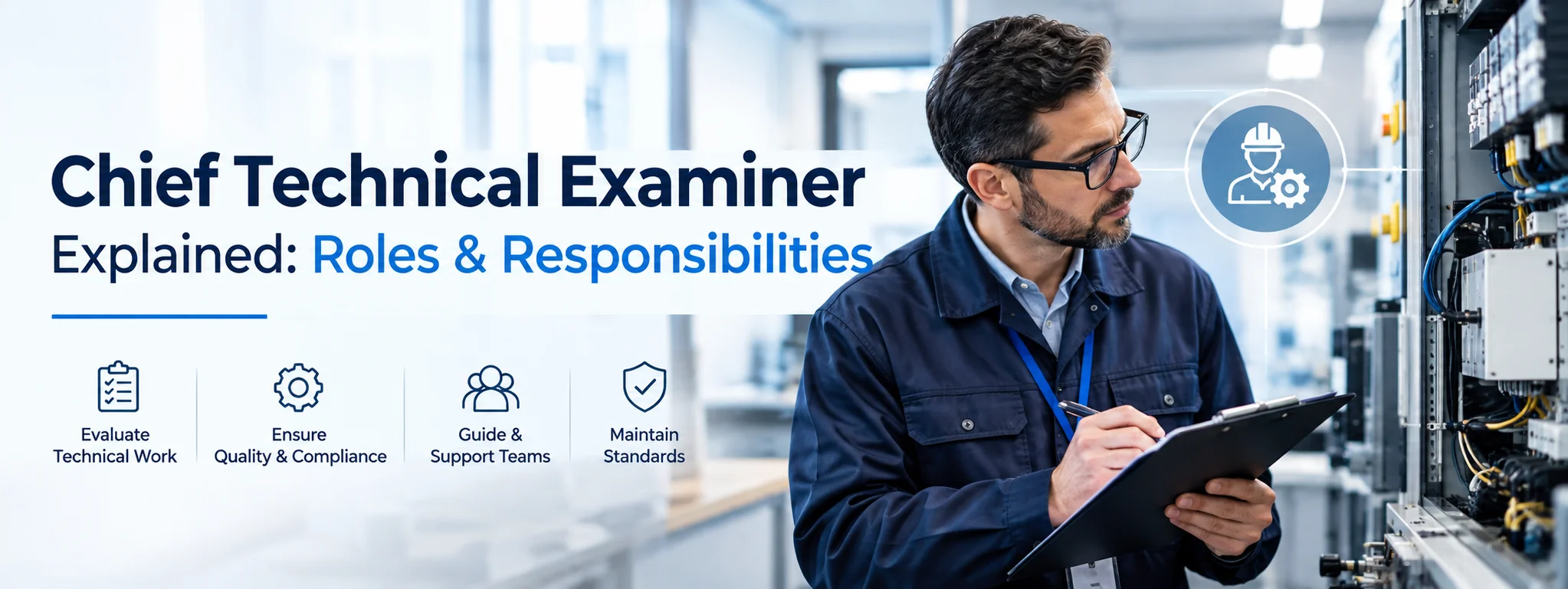
A chief technical examiner plays an important role in organizations where technical accuracy, engineering standards, inspections, and regulatory compliance are essential. This senior professional is generally responsible for supervising technical examinations, reviewing reports, ensuring that established procedures are followed, and helping management make informed decisions based on reliable technical findings.
The role can vary considerably depending on the organization, industry, and jurisdiction. In engineering, construction, manufacturing, transportation, government departments, and other technical fields, a chief technical examiner may oversee teams of examiners and inspectors while handling complex or high-value technical matters.
Understanding the responsibilities attached to this position can help professionals, students, organizations, and anyone researching technical administration understand how the role contributes to safety, quality, accountability, and operational performance.
Chief Technical Examiner: Core Role and Purpose
The chief technical examiner is usually a senior technical authority who coordinates examination activities and provides professional oversight. Rather than focusing only on individual inspections, the position often involves reviewing broader technical systems and ensuring that examination work is consistent, objective, and properly documented.
The role may involve examining projects, equipment, engineering work, contracts, specifications, maintenance procedures, or technical documentation.
Depending on the workplace, the examiner may be expected to:
- Supervise technical examination teams and assign responsibilities.
- Review inspection findings, measurements, calculations, and technical reports.
- Verify compliance with approved standards, specifications, and procedures.
- Identify technical risks, deficiencies, irregularities, or quality concerns.
- Provide recommendations to senior management based on examination results.
A strong chief technical examiner therefore needs more than technical knowledge. Leadership, communication, analytical thinking, professional judgment, and careful documentation are also important.
Key Responsibilities of a Chief Technical Examiner
The responsibilities associated with the position can differ between organizations, but several duties are commonly connected with senior technical examination.
Technical Inspection and Examination
One of the primary responsibilities is overseeing technical examinations. This can include checking whether work, equipment, materials, or systems meet established requirements.
The examiner may review inspection procedures and ensure that staff members use appropriate testing methods. In complicated cases, the chief technical examiner may personally examine technical evidence or participate in important inspections.
Accuracy is especially important because an incorrect technical conclusion can affect safety, project costs, compliance, and organizational decisions.
Reviewing Technical Reports
Technical examination generates documentation that must be clear, accurate, and supported by evidence.
A chief technical examiner may review reports prepared by engineers, inspectors, or technical officers. This review can involve checking calculations, photographs, test results, measurements, specifications, and conclusions.
The examiner may request additional information when a report is incomplete or when the available evidence does not adequately support a conclusion.
Ensuring Standards and Compliance
Another significant responsibility involves monitoring compliance with applicable technical standards, codes, specifications, and organizational procedures.
The examiner does not necessarily create every standard. Instead, the position often involves making sure that examination work and reviewed projects are evaluated against the correct requirements.
When a deviation is discovered, the examiner may document the issue and recommend corrective action.
Supervising Technical Staff
Because the word “chief” indicates a senior position, leadership is often an important part of the job.
A chief technical examiner may supervise technical examiners, inspectors, engineers, or supporting personnel. Responsibilities can include distributing assignments, reviewing performance, establishing examination priorities, and helping staff resolve complicated technical issues.
Effective supervision helps create consistency across different examination teams.
Investigating Technical Irregularities
Technical irregularities can arise from incorrect materials, poor workmanship, inaccurate measurements, documentation problems, equipment failures, or deviations from approved specifications.
When a significant issue appears, the chief technical examiner may coordinate an investigation. This requires collecting evidence, reviewing records, consulting specialists, and determining whether the issue is isolated or part of a larger problem.
The objective is generally to establish technically supported findings rather than rely on assumptions.
Chief Technical Examiner in Different Industries
The exact duties of a chief technical examiner depend heavily on the sector in which the person works.
Construction and Civil Engineering
In construction-related environments, the role may involve examining project quality, materials, structural work, measurements, specifications, and contract requirements.
The examiner may review whether construction activities correspond with approved designs and whether technical documentation accurately represents completed work.
Large infrastructure projects can require particularly detailed examination because mistakes may have substantial financial and safety consequences.
Manufacturing
In manufacturing, a chief technical examiner may oversee inspections involving machinery, production systems, components, materials, and quality-control procedures.
The focus can include dimensional accuracy, manufacturing standards, equipment performance, testing procedures, and production documentation.
Consistent examination can help organizations detect defects before products reach customers or enter critical systems.
Transportation and Infrastructure
Transportation organizations often depend on strict technical standards. Examination activities may involve vehicles, mechanical systems, infrastructure, maintenance records, or safety-related equipment.
The chief technical examiner can coordinate inspections and review technical findings to determine whether systems meet applicable requirements.
Government and Public-Sector Organizations
Government departments may use technical examination functions to review engineering projects, procurement activities, public works, contracts, and technical compliance.
In these environments, documentation and procedural consistency can be especially important because examination findings may support administrative decisions, project reviews, or accountability processes.
Skills Required for a Chief Technical Examiner
A successful chief technical examiner generally combines specialized technical knowledge with management and analytical capabilities.
Technical Knowledge
The professional needs a strong understanding of the relevant engineering or technical discipline. This may include construction, mechanical systems, electrical engineering, manufacturing, civil engineering, information systems, or another specialized field.
The exact knowledge requirements depend on the organization.
Analytical Thinking
Technical examination involves reviewing evidence and identifying relationships between observations and requirements.
Analytical thinking allows the examiner to distinguish a minor discrepancy from a serious technical concern and determine what additional evidence may be necessary.
Leadership
Supervising technical teams requires clear instructions, fair delegation, professional communication, and the ability to resolve disagreements.
The chief technical examiner may also mentor junior staff and help improve examination procedures.
Communication
Technical findings often need to be communicated to people with different levels of technical knowledge. Reports therefore need to be understandable without losing technical precision.
Strong communication is particularly valuable when explaining complicated findings to executives, project managers, contractors, or government officials.
Professional Judgment
Not every technical situation can be resolved by simply checking a single rule. Some cases require interpretation, additional investigation, or consultation with specialists.
Professional judgment helps the examiner determine how to proceed while maintaining objectivity and proper documentation.
Qualifications and Career Path
There is no single qualification that applies to every chief technical examiner position. Requirements depend on the employer, industry, and legal framework.
Many positions require a relevant degree or advanced technical qualification. Engineering-related roles may require an engineering degree and, depending on the jurisdiction, professional registration or licensing.
Practical experience is also highly valuable. A professional may begin as an engineer, inspector, technical officer, quality specialist, or examiner before progressing into a senior supervisory position.
A typical career path may include:
- Technical education in an appropriate engineering or specialist discipline.
- Entry-level technical employment involving inspections, engineering, testing, or quality control.
- Professional experience handling increasingly complicated technical assignments.
- Supervisory responsibilities involving teams, projects, or examination activities.
- Senior technical leadership with responsibility for examination standards and organizational oversight.
Continuous professional development can also help professionals remain familiar with changing standards, technology, regulations, and examination techniques.
A Chief Technical Examiner’s Typical Areas of Work
| Area | Typical Responsibility | Main Objective |
|---|---|---|
| Technical Examination | Review equipment, projects, materials, or systems | Verify technical requirements |
| Report Review | Examine findings, calculations, and evidence | Improve accuracy and reliability |
| Compliance | Check standards, specifications, and procedures | Identify deviations |
| Team Management | Supervise examiners and inspectors | Maintain consistent work |
| Investigation | Examine technical irregularities | Establish evidence-based findings |
| Recommendations | Provide technical observations to management | Support informed decisions |
| Documentation | Maintain examination records | Create a reliable audit trail |
The table demonstrates why the role is broader than simply performing inspections. A senior examiner often connects technical examination with management, documentation, quality assurance, and organizational accountability.
Importance of Documentation and Evidence
Documentation is a fundamental part of technical examination. An examination finding should normally be supported by evidence that another qualified professional can understand and review.
Useful evidence can include measurements, photographs, test results, drawings, specifications, contracts, maintenance records, inspection notes, and other relevant documentation.
A chief technical examiner may establish or enforce procedures that help ensure records are:
- Accurate and complete
- Clearly dated and identified
- Based on appropriate examination methods
- Consistent with applicable standards
- Easy to review or audit later
Good documentation creates a valuable record of how a technical conclusion was reached.
Challenges Faced by a Chief Technical Examiner
Senior technical examination is not always straightforward. Complex projects can involve incomplete records, conflicting information, changing requirements, tight deadlines, or multiple stakeholders.
Managing Complex Technical Problems
Some issues require several areas of expertise. A chief technical examiner may need to bring together engineers, inspectors, laboratory specialists, contractors, or other professionals.
Maintaining Objectivity
Technical findings should be based on evidence and applicable requirements. Maintaining professional objectivity can be important when examination results affect projects, budgets, contractors, or organizational decisions.
Keeping Up With Changing Standards
Technology and technical requirements change over time. Professionals in senior examination roles need to stay informed about relevant updates and ensure that teams use current procedures where applicable.
Balancing Speed and Accuracy
Organizations may want quick answers, but technical examination should not sacrifice necessary verification simply to meet a deadline. Finding the appropriate balance is an important part of senior technical management.
Technology in Technical Examination
Modern technology has changed how technical examinations are performed and documented.
Digital inspection systems can help teams collect information electronically, while specialized software can support calculations, data analysis, asset tracking, and report preparation.
Depending on the industry, examiners may also encounter technologies such as:
- Digital inspection forms and reporting systems
- Computer-aided design and engineering software
- Sensors and monitoring equipment
- Digital photographs and video evidence
- Data-analysis platforms
- Remote inspection technologies
- Document-management systems
Technology can improve efficiency, but technical judgment remains important. Digital tools provide information; qualified professionals still need to interpret that information correctly.
How the Role Supports Quality and Safety
A chief technical examiner can contribute to organizational quality by creating a structured process for identifying technical problems.
When examinations are performed carefully, organizations may detect deficiencies earlier and address them before they become more expensive or disruptive.
The role can also support safety when the examination process involves safety-critical equipment, structures, infrastructure, or systems. In such circumstances, accurate inspection and proper follow-up can be particularly important.
The examiner’s contribution is therefore not limited to finding problems. It can also involve improving processes, strengthening documentation, and encouraging consistent technical standards.
Difference Between an Examiner and a Chief Technical Examiner
A technical examiner may focus primarily on assigned inspections, testing, documentation, and technical assessments. A chief technical examiner generally has a wider supervisory and organizational role.
The chief position may involve reviewing the work of other examiners, establishing priorities, resolving complex cases, communicating findings to senior management, and helping maintain consistent examination practices.
However, titles vary significantly between organizations. The actual authority and responsibilities should always be determined from the employer’s job description, organizational structure, and applicable regulations.
Final Thoughts
The chief technical examiner is a senior technical role centered on examination, oversight, accuracy, compliance, and professional judgment. While the exact responsibilities differ between industries and organizations, the position commonly connects detailed technical work with broader management and quality objectives.
A capable examiner must understand technical requirements while also knowing how to evaluate evidence, supervise teams, document findings, investigate irregularities, and communicate conclusions clearly. As technology continues to transform inspection and reporting processes, the fundamental need for careful technical analysis and reliable professional judgment remains important.
For professionals considering this career, developing a strong technical foundation alongside leadership, communication, analytical, and documentation skills can provide a useful foundation for progressing toward senior examination responsibilities.
FAQs About Chief Technical Examiner
1. What does a chief technical examiner do?
A chief technical examiner oversees technical examination activities, reviews findings, supervises technical staff, and helps ensure compliance with relevant standards and procedures.
2. What qualifications are needed?
Requirements vary by industry and employer but may include a relevant technical degree, professional credentials, and substantial practical experience.
3. Is the role limited to engineering?
No. Similar positions can exist across construction, manufacturing, transportation, government, infrastructure, and other technical sectors.
4. Why is technical documentation important?
Documentation provides evidence supporting examination findings and creates a reliable record that can be reviewed, audited, or used for future decisions.
5. What skills are important for this position?
Technical expertise, analytical thinking, leadership, communication, attention to detail, professional judgment, and knowledge of applicable standards are commonly valuable.
1 thought on “Chief Technical Examiner Explained: Roles & Responsibilities”