
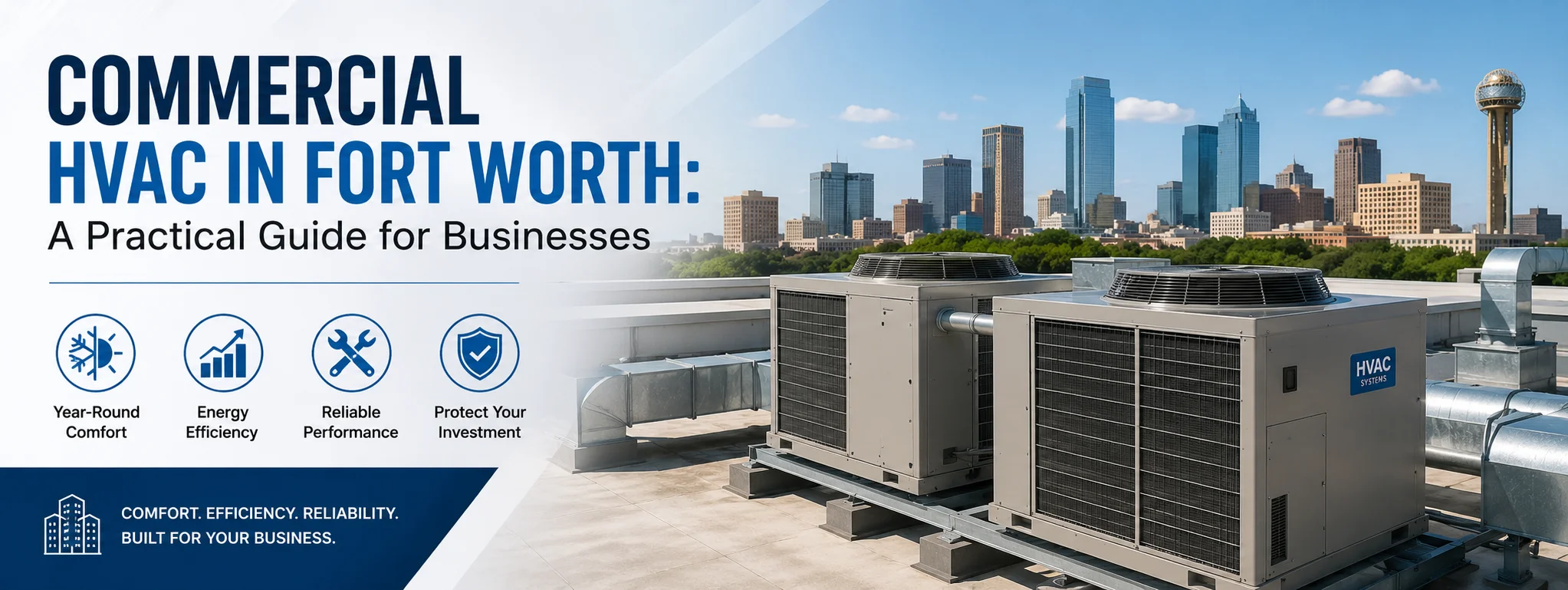
A dependable heating and cooling system is essential for businesses operating in Fort Worth. The area experiences long, hot summers, periods of high humidity, and occasional winter cold snaps, creating demanding conditions for commercial heating, ventilation, and air conditioning equipment. HVAC systems must work efficiently while keeping employees, customers, equipment, and products comfortable throughout changing weather conditions.
For a business owner or property manager, commercial HVAC is more than temperature control. A poorly performing system can increase energy consumption, create uncomfortable workspaces, contribute to poor indoor air quality, and lead to unexpected downtime. Choosing the right equipment and maintaining it properly can therefore have a direct effect on daily operations.
Why Commercial HVAC Matters in Fort Worth
Fort Worth businesses operate in a climate that can place considerable stress on HVAC equipment. During summer, high outdoor temperatures force air conditioning systems to operate for extended periods. Humidity adds another challenge because cooling equipment must also remove moisture from indoor air.
Commercial buildings can also have very different heating and cooling requirements depending on their size and purpose. A small professional office may need a relatively straightforward packaged system, while a warehouse, restaurant, medical facility, or large office building may require multiple units, advanced controls, dedicated ventilation, or specialized equipment.
Proper HVAC design helps maintain a more consistent indoor environment while avoiding unnecessary energy consumption.
Common Commercial HVAC Systems
Commercial properties in Fort Worth use several types of HVAC equipment. Rooftop units are particularly common in many offices, retail buildings, and restaurants because they combine heating and cooling equipment in a single package and keep major components outside the occupied space.
Other properties may use split systems, packaged systems, heat pumps, variable refrigerant flow systems, or larger centralized equipment. The appropriate choice depends on factors such as building size, occupancy, insulation, operating hours, layout, and the amount of heat produced inside the property.
| Commercial HVAC option | Common application | Main consideration |
|---|---|---|
| Rooftop units | Retail, offices, restaurants | Convenient packaged design |
| Split systems | Small commercial spaces | Flexible installation |
| Packaged systems | Offices and larger retail areas | Centralized heating and cooling |
| Heat pumps | Offices and mixed-use properties | Heating and cooling in one system |
| VRF systems | Multi-zone buildings | Independent zone control |
| Central systems | Large facilities | Suitable for substantial cooling loads |
A professional assessment is important before selecting equipment because installing a system that is too small or unnecessarily large can create performance and efficiency problems.
Commercial HVAC Installation
A successful installation begins before the equipment reaches the building. Contractors should evaluate the property’s heating and cooling requirements, existing ductwork, electrical capacity, ventilation requirements, building layout, and expected occupancy.
Correct sizing is particularly important. An undersized system may run continuously during extreme weather without adequately cooling the building. An oversized system can cycle inefficiently and may not provide effective humidity control.
Installation quality also matters. Even high-quality equipment can perform poorly if it is incorrectly configured, inadequately connected, or poorly integrated with existing building systems.
For new construction and major renovations, HVAC planning should take place early so ductwork, equipment locations, electrical requirements, controls, and ventilation can be coordinated with the rest of the project.
Preventive Maintenance Saves Businesses Trouble
Waiting until an HVAC system stops working is one of the costliest ways to manage commercial equipment. Preventive maintenance gives technicians an opportunity to identify developing problems before they become major failures.
A maintenance program can include filter replacement, coil inspection and cleaning, electrical checks, airflow testing, refrigerant evaluation, belt and motor inspection, condensate drainage checks, and control-system testing. Commercial HVAC providers commonly offer scheduled maintenance agreements designed around the building’s equipment and operating requirements.
Regular maintenance can also help identify declining performance. If one area of a building repeatedly becomes warmer than another, for example, the cause could involve airflow, controls, changing occupancy, equipment capacity, or other localized issues rather than simply a thermostat problem.
Signs Your Commercial HVAC System Needs Attention
Business owners and facility managers should pay attention to changes in system performance. Warning signs can include:
- Rooms that remain too hot or too cold
- Unusual sounds or vibrations
- Frequent equipment cycling
- Rising utility costs without a clear reason
- Weak airflow from vents
- Water around indoor equipment
- Persistent humidity problems
- Unusual odors
- Repeated equipment breakdowns
- An aging system requiring increasingly frequent repairs
Addressing these symptoms early may prevent a minor issue from developing into a major interruption.
Improving Commercial HVAC Efficiency
Energy efficiency should be considered throughout the life of a commercial HVAC system. Simple actions such as maintaining clean filters, keeping outdoor equipment clear, checking ductwork, and maintaining appropriate thermostat settings can support efficient operation.
Building controls can provide additional benefits. Modern controls can help businesses manage different areas according to occupancy and operating schedules instead of conditioning every part of a building in exactly the same way.
Humidity management is also important in Fort Worth. Excess moisture can contribute to discomfort and create conditions favorable to mold and material damage, making proper ventilation and dehumidification an important part of commercial indoor environmental management.
Choosing a Commercial HVAC Contractor
The contractor you choose can influence equipment performance for years. Businesses should look beyond the initial price and evaluate experience, licensing, insurance, maintenance capabilities, emergency support, warranties, and familiarity with commercial systems.
Ask potential contractors how they approach system sizing, maintenance, repairs, replacement decisions, and energy efficiency. A good contractor should be able to explain the problem clearly rather than simply recommending the most expensive solution.
It is also useful to choose a company capable of servicing the specific equipment installed at your property. Commercial HVAC providers in the Fort Worth area commonly work with rooftop units, packaged systems, split systems, heating equipment, controls, and preventive maintenance programs.
Repair or Replace?
When an HVAC system develops a problem, replacement is not automatically the best answer. A relatively new system with a repairable component may be worth fixing, while an older system experiencing repeated failures may justify replacement.
Businesses should consider the equipment’s age, repair history, operating costs, reliability, availability of replacement parts, and expected future maintenance expenses. Comparing the cost of continued repairs with the long-term benefits of newer equipment can make the decision easier.
For larger commercial properties, a phased replacement strategy may also reduce disruption by allowing equipment to be upgraded section by section.
Final Thoughts
Commercial HVAC in Fort Worth requires thoughtful planning because local weather can place significant demands on heating and cooling equipment. Reliable HVAC performance supports comfortable workplaces, better customer experiences, healthier indoor environments, and uninterrupted business operations.