
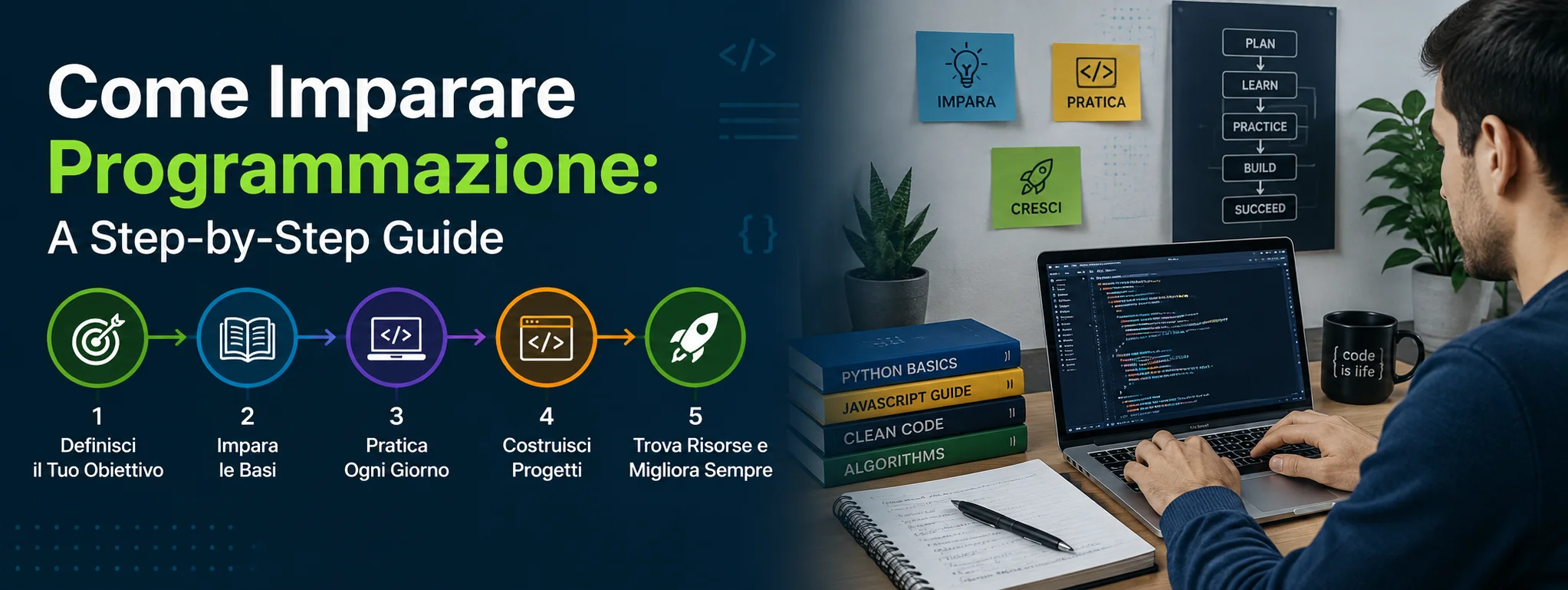
Learning how to code (“come imparare la programmazione”) can feel like trying to decipher an ancient dialect without a translation dictionary. The tech world is flooded with jargon, endless frameworks, and conflicting advice about which language you should learn first. However, stripped down to its core, programming is not about memorizing syntax—it is about problem-solving, structured logic, and building tools to automate tasks or create new experiences.
Whether you want to launch a new career, automate tedious tasks at work, or bring an app idea to life, here is a practical, step-by-step roadmap to guide you from complete beginner to a confident coder.
1. Demystify What Programming Actually Is
Before writing a single line of code, it helps to understand what you are actually doing. Computers are remarkably fast, but exceptionally literal. They do not possess intuition; they simply execute commands. Programming is the act of giving a computer a explicit, unambiguous set of instructions to solve a problem.
When you learn to code, you are training your brain to think in algorithms—step-by-step procedures for solving a problem. Once you learn how to break down a complex task into tiny, logical steps, learning the actual code syntax becomes much easier.
2. Choose Your First Programming Language
One of the biggest traps for beginners is “language paralysis”—spending weeks debating whether to start with Python, JavaScript, C++, or Java. The truth is, your first language is simply a medium to learn fundamental programming concepts like variables, loops, conditionals, and functions. Once you master these concepts in one language, picking up a second or third becomes significantly easier.
Here is a quick breakdown to help you pick based on your goals:
| Language | Best For | Why Choose It? |
| Python | Data Science, AI, Web Backends, Beginners | Clean, readable syntax that closely resembles plain English. |
| JavaScript | Web Development (Front-end & Back-end) | The native language of the web; runs in every browser instantly. |
| Swift | iOS App Development | Modern, safe, and designed specifically for Apple platforms. |
| Java / C# | Enterprise Software, Game Development | Strongly typed languages that teach deep object-oriented principles. |
Recommendation: If you aren’t sure, start with Python or JavaScript. Python offers the gentlest learning curve, while JavaScript gives you instant visual results in your web browser.
3. Master the Core Fundamentals First
Resist the urge to jump straight into building complex machine learning models or 3D video games. Start small and gain confidence by mastering the core building blocks present in almost every programming language:
-
Variables: Containers for storing data (e.g., numbers, text, user choices).
-
Data Types: Understanding strings, integers, floats, and booleans.
-
Conditionals (
if/else): Logic that allows your program to make decisions based on specific conditions. -
Loops (
for/while): Instructing the computer to repeat an action until a condition is met. -
Functions: Reusable blocks of code that take inputs, perform an operation, and return an output.
-
Data Structures: Lists, arrays, and dictionaries used to organize and manipulate collections of data.
Spend a few weeks writing small script-based programs—like a text-based calculator, a simple guessing game, or a basic unit converter—to make these concepts second nature.
4. Adopt a “Build-First” Mindset
Reading books and watching video tutorials can give you a false sense of competence, often called “tutorial hell.” You might follow along with an instructor for hours, only to stare at a blank editor screen when trying to write code on your own.
To truly learn, you must write code yourself. Apply the 20/80 rule: spend 20% of your time consuming instructional content and 80% building projects.
Beginner Project Ideas
-
To-Do List Application: Teaches CRUD (Create, Read, Update, Delete) operations and state management.
-
Weather App: Teaches how to connect to external APIs and handle dynamic data.
-
Personal Portfolio Website: Teaches structure, layout, and deployment.
-
Expense Tracker: Teaches data handling, math operations, and simple user interaction.
5. Get Comfortable with Debugging and Googling
Errors and broken code are not signs of failure; they are an inherent part of a software developer’s daily workflow. Learning how to debug efficiently is what separates successful learners from those who quit.
When your code throws an error:
-
Read the error message carefully. It usually tells you exactly which line failed and why.
-
Isolate the problem. Comment out sections of code to find where the breakdown occurs.
-
Search strategically. Copy and paste exact error messages into Google or developer forums like Stack Overflow. Learning how to search for solutions is one of the most critical tech skills you can develop.
6. Embrace Essential Developer Tools
As you move past basic scripts, familiarize yourself with the tools professional developers use every day:
-
Code Editors: Install Visual Studio Code (VS Code)—the industry standard text editor with excellent extension support.
-
Version Control (Git & GitHub): Git tracks changes in your code over time, while GitHub allows you to store your projects online, showcase your work to employers, and collaborate with others.
-
Command Line (Terminal): Learn basic terminal commands to navigate directories, manage files, and execute scripts without a graphical interface.
7. Consistency Over Intensity
Coding is a skill built through muscle memory and mental repetition. Writing code for 30 minutes every day is far more effective than binge-coding for eight hours once every two weeks. Daily interaction keeps logic concepts fresh and builds momentum.
Final Thoughts
Learning how to program (“imparare la programmazione”) is a marathon, not a sprint. You will encounter frustration, confusion, and moments where nothing seems to work. Accept those moments as natural steps in the learning process. Celebrate the small victories—like fixing a bug that kept you stuck for hours or seeing your first function run successfully. Stay curious, build real things, and focus on steady progress over perfection.