
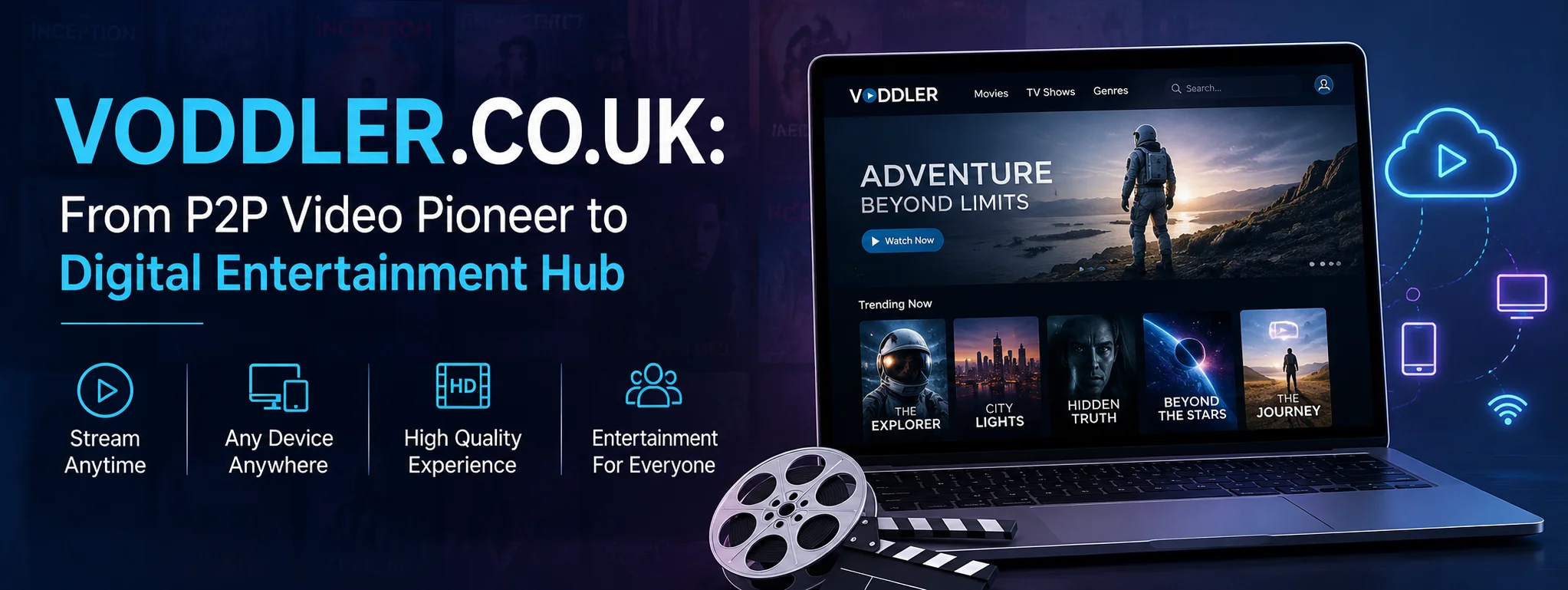
In the early days of high-speed home internet, online video streaming was a wild, uncharted frontier. Physical formats like DVDs and Blu-rays still dominated homes, while digital distribution was caught in a tug-of-war between piracy networks and restrictive DRM systems. Long before multi-billion-dollar global platforms turned on-demand video into an everyday utility, an ambitious Swedish tech startup introduced a concept dubbed by early media as the “Spotify for movies”.
That legacy, along with its UK-oriented portal, voddler.co.uk, represents one of the most intriguing chapters in the evolution of modern home media. Understanding what Voddler was, how its technology challenged existing delivery norms, and what the domain signifies today offers valuable insights into the architecture of modern media streaming.
The Origins of a Streaming Pioneer
Founded in Stockholm, Sweden, in 2005 by Martin Alsen, Magnus Dalhamn, and Mattias Bergström, Voddler set out with a simple yet ambitious goal: create a completely legal, studio-backed streaming ecosystem.
At the time, the biggest challenge to online video distribution was cost and network strain. High-definition video files required massive bandwidth, making traditional centralized server infrastructure prohibitively expensive for a free or low-cost consumer service.
To solve this, Voddler developed a proprietary hybrid peer-to-peer (P2P) architecture called Vnet.
How the Vnet Architecture Operated
Unlike conventional platforms that rely entirely on central Content Delivery Networks (CDNs) to stream every piece of data directly to individual devices, Vnet functioned as a managed network:
-
Node Distribution: When a user watched a film, their device temporarily cached small chunks of encrypted video data.
-
Peer Sharing: When subsequent viewers pressed play, their stream drew data in parallel from both nearby user devices and central servers.
-
Central Control: Crucially, unlike non-commercial torrenting networks, Vnet maintained a strict central administrator. Rights verification, access permissions, and digital encryption were managed entirely from Voddler’s core servers.
This hybrid model enabled data distribution efficiency, dramatically lowering server overhead and proving that large-scale streaming could operate outside traditional server-farm constraints.
The Push for Western Europe and voddler.co.uk
Following its Scandinavian launch, Voddler looked toward international expansion. United Kingdom viewers presented a prime audience: high broadband penetration rates, a strong culture of media consumption, and a growing demand for legitimate, on-demand digital alternatives to broadcast television.
The domain voddler.co.uk became part of this regional footprint. It targeted English-speaking audiences with tailored content guides, local licensing agreements, and localized user engagement.
Through deals with major Hollywood studios—including Warner Bros., Paramount, Sony, and Disney—Voddler demonstrated that movie studios were willing to explore legal digital delivery if rights management and security remained intact.
Technical Hurdles and Market Shifts
Despite its technical brilliance, the original Voddler consumer service faced operational hurdles that eventually altered its path.
1. The P2P Streaming Dynamic
While peer-to-peer delivery drastically reduced network costs, its performance depended on active user participation. In areas with lower user density or asymmetric internet speeds (where upload rates were far slower than download rates), viewers could experience latency and variable stream quality.
2. Complex Licensing Economics
Securing global streaming rights for top-tier film catalogs proved fundamentally different from music licensing. Complex territorial windows, expensive upfront minimum guarantees, and fluctuating distribution deals made maintaining a static, free-to-watch ad-supported catalog a constant challenge.
3. Rapid Infrastructure Evolution
As global cloud infrastructure matured, standard CDNs became significantly cheaper and more efficient. The core financial advantage of P2P streaming began to diminish relative to traditional server networks, prompting Voddler to shift its primary business model toward licensing its underlying technology (Vnet) directly to other enterprise platforms rather than running a consumer-facing service.
The original Swedish parent enterprise ultimately closed its doors in 2018, marking the end of its first-wave streaming platform.
What Is voddler.co.uk Today?
Because domain names frequently transition over time, searching for voddler.co.uk today connects users with its modern digital identity.
Rather than functioning as the original peer-to-peer software platform of the early 2010s, the current domain serves as an informational web hub and digital media reference site. It primarily focuses on:
-
Streaming Industry Insights: Coverage of shifting trends across modern subscription platforms, video-on-demand tech, and home entertainment setups.
-
Media Guides & Recommendations: Crated platform comparisons, viewing recommendations, and media consumption overviews for readers interested in digital entertainment.
-
Technology Trends: Discussions regarding decentralization, media delivery infrastructure, and how emerging web networks continue to reshape distribution.
Key Takeaways from the Voddler Journey
| Era | Primary Model | Technical Core | Primary Focus |
| Early Voddler Era | Ad-Supported VOD (AVOD) & Rentals | Hybrid P2P (Vnet) | Consumer Movie Streaming Platform |
| Mid-Stage Expansion | B2B Technology Licensing | Standalone Vnet CDN Integration | Enterprise OTT Delivery Infrastructure |
| Modern Domain Era | Information & Digital Content | Standard Web Architecture | Entertainment News, Guides & Streaming Insights |
Voddler’s original strategy highlights critical truths about technology adoption:
-
Innovation Requires Perfect Timing: Voddler introduced decentralized streaming long before decentralized web tools became mainstream.
-
User Experience Wins: Regardless of how efficient an underlying back-end technology is, end-users prioritize effortless, buffer-free, single-click playback above all else.
-
Content Rights Rule Media: Technology opens the door, but sustainable licensing agreements determine long-term survival in commercial media distribution.
Final Thoughts
The narrative behind voddler.co.uk is a microcosm of how the internet evolved over two decades. It began as a bold experiment to democratize online cinema using peer-to-peer networks, helping pave the path for modern video-on-demand services. Today, as a digital publication portal, the domain remains linked to the world of home media, bridging past technology concepts with contemporary streaming discussions. As decentralized networks, edge computing, and new distribution frameworks continue to develop, the core ideas pioneered by platforms like Voddler remain as relevant as ever.