
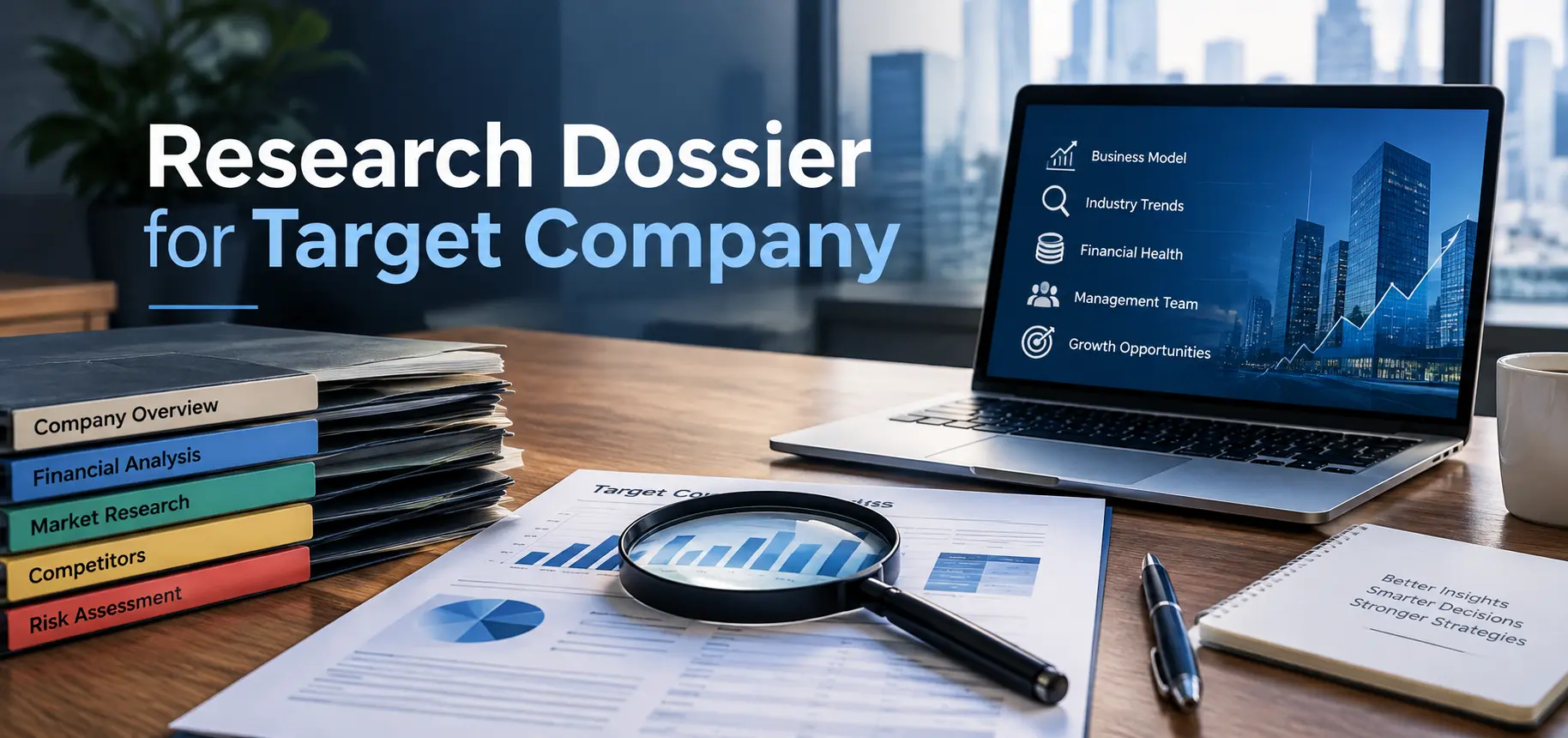
A Research Dossier for Target Company is a structured way to collect, verify, and analyze important information about a business. Instead of relying on scattered notes, random search results, or promotional claims, a well-prepared dossier brings company background, operations, finances, leadership, competitors, market conditions, risks, and opportunities into one organized report.
Whether the research is being prepared for investment research, competitive analysis, sales preparation, partnership evaluation, academic work, or business planning, the goal is the same: build a clear evidence-based picture of the organization. A strong dossier also records where important information came from, helping readers distinguish confirmed facts from estimates and interpretation.
Why a Research Dossier for Target Company Matters
Business information can change quickly. Leadership may change, products can be discontinued, financial results may shift, and competitors can introduce new services. A structured Research Dossier for Target Company makes these developments easier to track and compare over time.
The research should begin with a clear purpose. A person studying a potential supplier may focus on operations and reliability, while an investor may spend more time examining financial performance and corporate risks. A sales researcher could instead concentrate on customers, products, decision-makers, and business priorities.
A useful dossier should help answer questions such as:
- Who owns and manages the company?
- How does the company generate revenue?
- Which products or services are most important?
- Which markets and customers does it serve?
- Who are its major competitors?
- What financial information is publicly available?
- Which risks could affect future operations?
This focused approach prevents the report from becoming a huge collection of irrelevant information.
Building the Research Dossier for Target Company
The first stage is to establish the company’s identity and research boundaries. Confirm the legal name, official website, headquarters, industry, ownership structure, geographic markets, and relevant subsidiaries. This is particularly important when businesses have similar names or operate through multiple corporate entities.
Next, establish the research objective and reporting period. For example, a dossier might examine a company’s performance during the latest fiscal year or investigate its position within a specific market. Financial figures, employee numbers, market data, and leadership information should always be connected to an appropriate date.
Company Background and Business Model
The background section should explain how the organization developed and how it operates today. Relevant information can include its founding, major milestones, acquisitions, expansion, product launches, and significant organizational changes.
The business model deserves particular attention. Research should examine how the company creates value, who its customers are, how products reach those customers, and where revenue is generated.
Important areas include:
- Revenue sources and major business segments
- Main products and services
- Target customers and geographic markets
- Distribution and sales channels
- Pricing or subscription structures
- Partnerships and strategic relationships
Understanding these elements gives the research useful context rather than simply listing company facts.
Leadership, Workforce, and Operations
Leadership can reveal important information about organizational structure and strategic direction. Research the current executives, board structure, founders, major ownership interests, and relevant leadership changes.
Operational research should examine facilities, workforce size, technology, supply chains, production systems, distribution networks, and other capabilities where reliable information is available.
However, employee counts and operational estimates can vary between sources. The dossier should therefore include the date and source for each important figure instead of presenting an outdated number as current.
Financial and Market Analysis
Financial research is often one of the most important sections of a company dossier. For public companies, annual reports, regulatory filings, investor presentations, and audited statements can provide valuable primary evidence. Private companies may provide considerably less information, requiring greater caution with third-party estimates.
Useful financial indicators can include revenue, operating income, net income, cash flow, debt, assets, margins, and year-over-year changes. The meaning of each figure depends on the reporting period and business model.
| Research Area | Information to Collect | Why It Matters |
|---|---|---|
| Company Profile | Legal name, headquarters, ownership | Confirms company identity |
| Business Model | Products, customers, revenue sources | Explains how the company operates |
| Financials | Revenue, profit, debt, cash flow | Provides financial context |
| Market | Industry, trends, geographic reach | Shows external conditions |
| Competition | Major competitors and positioning | Provides market context |
| Leadership | Executives, board, ownership | Clarifies management structure |
| Risk | Legal, operational, financial risks | Identifies potential exposure |
| Evidence | Sources, dates, verification status | Improves research reliability |
Market research should then place the company within its wider environment. Examine industry trends, customer behavior, technological changes, regulation, economic conditions, and competitor activity. This helps explain whether a company is operating in a growing, changing, or challenging environment.
Competitor and Reputation Research
Competitor analysis should not simply create a list of similar companies. It should examine meaningful differences in products, pricing, geographic reach, customer segments, technology, distribution, and market strategy.
Public reputation can also provide useful context. Review reputable business publications, official announcements, customer feedback platforms, industry discussions, and other relevant sources. However, isolated reviews or social media comments should not automatically be treated as representative of the entire customer base.
A strong dossier separates documented evidence from interpretation. If several independent sources report the same development, confidence in the information increases. If sources disagree, the disagreement should be recorded rather than quietly choosing one version.
Risks, Opportunities, and Evidence Quality
A valuable dossier does more than identify attractive opportunities. It also examines issues that could create uncertainty or financial pressure.
Potential research areas include regulatory changes, litigation, cybersecurity, supply-chain disruption, customer concentration, debt exposure, changing consumer behavior, technological disruption, and competitive pressure.
At the same time, researchers can investigate documented opportunities such as geographic expansion, new products, partnerships, technological development, increasing demand, or entry into emerging markets.
The quality of the evidence is equally important. Researchers should prioritize primary sources where possible and use independent sources to verify important claims. A structured dossier should clearly distinguish:
Verified facts: Information directly supported by reliable evidence.
Estimates: Third-party calculations or figures that may not be officially confirmed.
Analysis: Conclusions or interpretations developed from the available evidence.
This distinction makes the report more transparent and reduces the risk of presenting assumptions as facts.
Practical Research Workflow
A repeatable workflow can make the Research Dossier for Target Company faster and more reliable.
- Define the objective — Decide exactly why the company is being researched.
- Confirm company identity — Verify the legal entity, website, ownership, and relevant subsidiaries.
- Collect primary evidence — Start with official company documents, regulatory filings, and other authoritative records.
- Expand the research — Use reputable industry publications and independent sources to add context.
- Record sources immediately — Note the source, publication date, and relevant information while researching.
- Cross-check important claims — Look for supporting evidence before treating significant information as established.
- Separate fact from analysis — Clearly label estimates, interpretations, and unresolved issues.
- Review the dossier — Remove outdated information and identify important research gaps.
This process turns scattered information into a practical research resource that can be updated when new evidence appears.
Common Mistakes to Avoid
One common mistake is relying too heavily on the company’s own marketing material. Corporate websites are useful primary sources, but promotional language does not provide the same perspective as audited records or independent reporting.
Another problem is using old information without mentioning its date. Leadership, financial results, product offerings, and market conditions can change considerably.
Researchers should also avoid copying competitor claims without verification. Market-share figures, customer numbers, website traffic estimates, and private-company valuations may come from different methodologies.
Finally, do not hide uncertainty. If information cannot be confirmed, say so. A transparent limitation is more useful than a confident but unsupported statement.
Final Thoughts
A Research Dossier for Target Company provides a powerful framework for turning scattered business information into organized intelligence. The most useful dossier combines company history, business operations, leadership, financial information, market conditions, competitors, risks, opportunities, and reliable supporting evidence.
The strength of the report does not depend only on how much information it contains. Accuracy, relevance, source quality, dates, and clear separation between facts and interpretation are equally important. A concise dossier built around reliable evidence can be far more useful than a lengthy report filled with unsupported claims.
By defining the research objective first, verifying important information, recording sources, and regularly updating significant developments, researchers can create a practical document that remains useful long after the initial research is complete.
FAQs
1. Who can use a company research dossier?
Investors, marketers, sales teams, consultants, researchers, students, and business owners can use a dossier for different research purposes.
2. How long should a company dossier be?
There is no fixed length. The appropriate size depends on the company, research objective, industry, and amount of reliable information available.
3. Should private companies be researched differently?
Yes. Private companies often disclose less financial information, so third-party estimates should be clearly labeled and verified whenever possible.
4. Which sources are useful for company research?
Official company documents, regulatory filings, annual reports, government records, reputable business publications, and credible industry sources are useful starting points.
5. How often should a dossier be updated?
Update it when significant information changes, especially financial results, leadership, ownership, products, legal developments, and major market events.