
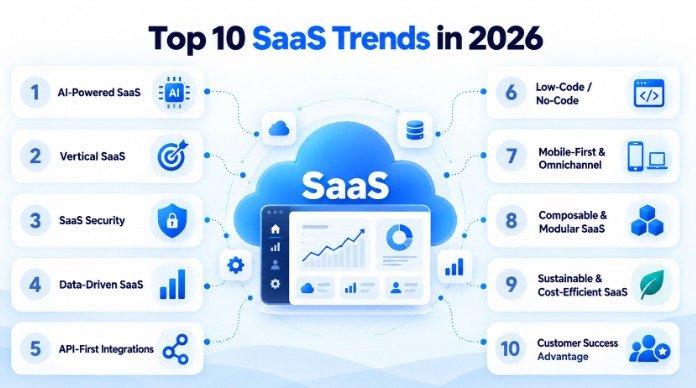
SaaS is evolving rapidly as businesses look for more flexible, scalable, and intelligent ways to manage software and digital operations. Emerging technologies such as AI, automation, data analytics, APIs, and cloud computing are changing how SaaS platforms are developed and used.
In this blog, we’ll discuss the top SaaS trends shaping the industry in 2026, their impact on businesses, and how organizations can prepare for the future of SaaS.
What are SaaS Trends?
SaaS trends reflect the changing technologies, customer expectations, and development practices shaping Software as a Service products. They influence how SaaS platforms are built, integrated, secured, delivered, and optimized for different business needs.
From AI-powered features to modular architectures and advanced analytics, modern SaaS platforms are becoming smarter and more adaptable. Businesses that understand these changes can make better technology decisions and build software that remains competitive as requirements evolve.
Why are SaaS Trends Important for Businesses?
The SaaS market continues to evolve as businesses seek software that reduces operational complexity, improves productivity, and supports faster growth. Emerging trends can help organizations identify new opportunities to automate processes and improve customer experiences.
Keeping up with SaaS trends also helps businesses evaluate whether their existing software infrastructure can support future requirements. It allows them to prioritize investments in areas such as AI, security, integrations, analytics, and scalability.
How is SaaS Evolving in 2026?
SaaS platforms are moving beyond traditional cloud-based software toward more intelligent, connected, and customizable solutions. Businesses increasingly expect SaaS applications to provide automation, real-time insights, seamless integrations, and personalized experiences.
AI is also becoming an important part of SaaS development, enabling intelligent assistants, predictive capabilities, automated workflows, and content generation. At the same time, security, data management, cost optimization, and flexible architecture remain important priorities for SaaS businesses.
Top 10 SaaS Trends to Watch in 2026
The SaaS landscape is changing rapidly as businesses adopt new technologies and look for more efficient ways to deliver software. The following trends are expected to influence SaaS development, adoption, and business strategies in 2026.
- AI-Powered SaaS Becomes the New Standard
Artificial Intelligence is becoming a core capability within modern SaaS platforms rather than an optional feature. Businesses are integrating AI to automate repetitive tasks, analyze information, personalize experiences, and provide intelligent recommendations.
Generative AI, AI assistants, and copilots can help users complete tasks directly within SaaS applications. AI-powered features can also analyze large datasets and provide actionable insights, helping businesses improve productivity and decision-making.
- Vertical SaaS for Industry-Specific Needs
Vertical SaaS focuses on meeting the specific requirements of a particular industry rather than offering generic functionality for multiple sectors. These platforms can be designed around industry workflows, regulations, terminology, and operational processes.
Healthcare, finance, retail, manufacturing, and logistics businesses can benefit from specialized SaaS applications.
For example, AI in healthcare SaaS can help organizations build more intelligent, industry-specific software solutions. Industry-focused platforms can reduce customization requirements and provide features that closely match the needs of their target users.
- SaaS Security Takes Center Stage
As businesses store more sensitive information in cloud applications, security is becoming a major consideration when adopting and developing SaaS platforms. Organizations need to protect customer information, business data, application access, and integrations.
Modern SaaS cloud security practices are increasingly focused on stronger identity management, encryption, access controls, continuous monitoring, and zero-trust security practices. Security and compliance need to be considered throughout the SaaS development lifecycle rather than added after deployment.
- SaaS Platforms Become More Data-Driven
Modern SaaS applications are increasingly using data analytics to help businesses understand performance and make informed decisions. Real-time dashboards, reporting, predictive analytics, and embedded business intelligence can turn application data into actionable insights.
Data-driven SaaS platforms can help users monitor key metrics without moving information between multiple systems. This creates a more connected experience while helping organizations make faster operational and strategic decisions.
- API-First SaaS and Seamless Integrations
Businesses rarely operate using a single software platform. They rely on CRM, ERP, payment, marketing, analytics, communication, and other business applications that need to work together.
API-first SaaS development makes it easier to connect platforms and exchange data between applications. Strong integration capabilities can eliminate data silos, automate workflows, and create a more connected technology ecosystem.
- Low-Code and No-Code SaaS Development
Low-code and no-code technologies are making application development more accessible by reducing the amount of traditional programming required for certain use cases. Businesses can use visual interfaces, reusable components, and prebuilt workflows to create applications and automate processes.
These platforms can help development teams build solutions faster while allowing business users to participate more actively in application development. AI capabilities are also making low-code and no-code tools more powerful and easier to use.
- Mobile-First and Omnichannel SaaS Experiences
Users increasingly expect SaaS applications to work smoothly across desktops, smartphones, and tablets. Mobile-first SaaS development focuses on delivering responsive interfaces and essential functionality across different devices.
Businesses also want consistent experiences across multiple channels. A connected omnichannel approach lets users access the same information and workflows regardless of the device or platform they use.
- Composable and Modular SaaS Architecture
Composable SaaS architecture allows businesses to combine modular software components based on their specific requirements. Instead of depending on one large application with every possible feature, organizations can use selected capabilities that fit their workflows.
This approach improves flexibility and makes it easier to scale or modify applications as business requirements change. Modular architectures can also support faster development and integration with other systems.
- Sustainable and Cost-Efficient SaaS
As cloud usage increases, businesses are paying greater attention to infrastructure efficiency and SaaS operating costs. Organizations are looking for ways to reduce unnecessary resource consumption while maintaining application performance.
Cloud resource optimization, efficient architecture, workload monitoring, and FinOps practices can help businesses manage SaaS costs more effectively. Sustainable technology practices can also support more responsible use of computing resources.
- Customer Success Becomes a Competitive Advantage
SaaS businesses are placing greater emphasis on customer success because retaining existing customers is essential for long-term growth. Modern platforms are using product usage data, personalized onboarding, automation, and proactive support to understand customer needs.
AI can further support customer success by identifying usage patterns, predicting potential churn, and recommending relevant actions. A strong customer success strategy can improve product adoption, satisfaction, and long-term customer relationships.
Key Benefits of Following Emerging SaaS Trends
Keeping up with emerging SaaS developments can help businesses make informed technology decisions and adapt to changing market expectations. The right trends can support both operational improvements and long-term growth.
- Faster Digital Transformation
Modern SaaS technologies can help businesses adopt AI, automation, analytics, and cloud capabilities without building every component from scratch. This can accelerate digital transformation initiatives and reduce the time required to introduce new capabilities.
- Improved Operational Efficiency
AI-powered automation, integrated workflows, and data-driven tools can reduce repetitive manual activities. Employees can focus on strategic tasks while software handles routine processes.
- Better Customer Experiences
Modern SaaS platforms can provide personalized recommendations, intelligent assistance, faster support, and consistent experiences across devices. These capabilities help businesses respond more effectively to changing customer expectations.
- Greater Scalability
Cloud-based SaaS architecture lets businesses scale applications and resources based on demand. Modular, flexible architectures also make it easier to introduce new features as the organization grows.
- Stronger Competitive Position
Adopting relevant SaaS trends can help businesses improve products, optimize operations, and respond faster to market changes. Organizations that continuously evaluate emerging technologies can identify opportunities before they become standard expectations.
How Businesses Can Prepare for the Future of SaaS
Following every emerging trend is not always the right approach for every business. Organizations should evaluate trends based on their business goals, customer requirements, existing infrastructure, and available resources.
A structured approach can help businesses adopt technologies that provide measurable value instead of investing in trends simply because they are popular.
- Evaluate Current SaaS Infrastructure
Businesses should review their existing SaaS applications, integrations, data flows, security controls, and operational processes. This assessment can identify outdated systems, duplicate tools, integration gaps, and opportunities for improvement.
Understanding the current environment provides a foundation for deciding which emerging technologies to adopt or upgrade.
- Identify High-Value Automation Opportunities
Businesses should identify repetitive and time-consuming workflows that could benefit from automation or AI. Customer support, reporting, data processing, marketing workflows, and internal operations can often provide suitable starting points.
Prioritizing high-value use cases helps organizations demonstrate measurable benefits before expanding their SaaS automation initiatives.
- Strengthen Data and Security Practices
AI-powered and data-driven SaaS platforms require reliable data and strong security practices. Businesses should establish appropriate access controls, data governance, encryption, monitoring, and backup processes.
A strong foundation helps organizations adopt new SaaS capabilities while reducing security and data management risks.
- Prioritize Integration and Scalability
Businesses should select SaaS platforms that can integrate with their existing technology ecosystem and scale with future requirements. Consider APIs, flexible architecture, and integration capabilities during technology selection.
This reduces the risk of creating disconnected systems as the organization adopts more SaaS applications.
- Choose the Right SaaS Development Partner
An experienced development partner can help businesses evaluate SaaS opportunities, select suitable technologies, develop custom applications, and integrate them with existing systems.
The right partner should understand the organization’s business objectives, not just the technical implementation. This helps ensure the resulting SaaS solution delivers practical, measurable value.
How BigDataCentric Helps Businesses Build Future-Ready SaaS Solutions?
BigDataCentric helps businesses develop customized SaaS solutions by combining software development with AI, data, analytics, automation, and integration capabilities. Its approach focuses on building solutions around specific business requirements rather than relying on one-size-fits-all platforms.
- Custom SaaS Application Development
BigDataCentric develops customized SaaS applications designed around specific business workflows and customer requirements. Solutions can be designed with scalable architecture, user-friendly interfaces, and functionality aligned with business objectives.
Custom SaaS development can help organizations turn unique business processes into scalable digital products while maintaining flexibility for future enhancements.
- AI-Powered SaaS Development
AI can add intelligent capabilities to SaaS platforms, including automated workflows, recommendations, conversational interfaces, predictive analytics, and AI assistants.
BigDataCentric can integrate AI and Machine Learning capabilities into SaaS applications to help businesses automate processes, improve user experiences, and generate more value from their data.
- SaaS Integration and API Development
BigDataCentric helps businesses connect SaaS applications with existing enterprise systems and third-party platforms. API development and integration can enable secure data exchange between CRM, ERP, payment, analytics, and other business applications.
Connected systems can reduce manual data entry, eliminate information silos, and support more efficient workflows.
- Data Analytics and Embedded BI
Businesses can integrate analytics and business intelligence capabilities directly into SaaS platforms. BigDataCentric can help build dashboards, reports, and data-driven features that allow users to access insights within their existing workflows.
Embedded analytics can make business data more accessible while supporting faster and more informed decisions.
- SaaS Automation and Optimization
BigDataCentric can help businesses identify repetitive processes that can be automated through AI, Machine Learning, APIs, and workflow automation. Automation can improve productivity while reducing manual effort and operational inefficiencies.
The company can also help optimize SaaS solutions as business requirements evolve, ensuring the platform remains scalable, efficient, and aligned with long-term goals.
Conclusion
SaaS is evolving rapidly as AI, automation, analytics, security, integration, and flexible architectures become increasingly important. The latest SaaS trends are not only changing how software is developed but also how businesses use technology to improve operations and customer experiences.
Businesses should focus on the trends that align with their specific goals rather than adopting every new technology. With the right strategy, architecture, and development expertise, organizations can build SaaS solutions that are scalable, intelligent, secure, and prepared for future growth.