
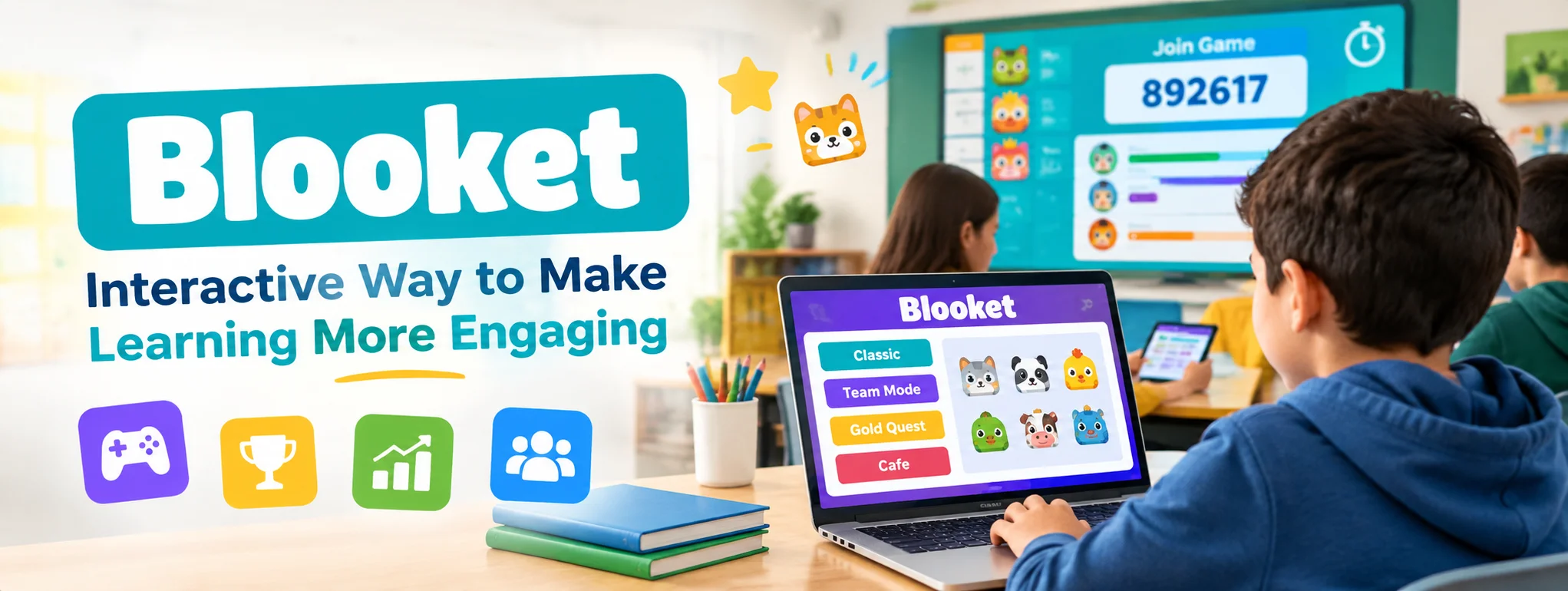
Learning does not always have to involve textbooks, long assignments, and traditional quizzes. With the growth of educational technology, teachers now have access to interactive platforms that can turn ordinary classroom activities into engaging experiences. Blooket is one such platform that combines quiz-based learning with games, allowing students to review information while participating in an entertaining digital activity.
Blooket has become popular among educators because it provides a different approach to classroom review. Instead of simply answering questions and waiting for a score, students can participate in game modes where their answers can influence their progress. This combination of questions, competition, and strategy can make revision sessions more exciting for learners.
How Blooket Works
Blooket is designed around question sets that can be used during classroom games. A teacher can create a new set of questions or use an existing collection of questions from the platform. These questions can cover subjects such as mathematics, science, history, vocabulary, geography, and many other topics.
Once a question set is ready, the teacher selects a game mode and starts a session. Students can then join the game using the information provided by their teacher. Depending on the selected mode, students answer questions and receive rewards or advantages within the game.
The important point is that the educational content remains at the center of the activity. Students still need to understand and answer questions correctly, but the surrounding game mechanics make the process more interactive.
Why Students Enjoy Blooket
One of the biggest strengths of Blooket is its ability to make repetitive review feel less like ordinary studying. Students often respond positively to activities that provide immediate feedback and a sense of progress.
The platform also includes collectible characters known as Blooks. These characters give the experience a playful identity and can make participation more appealing, especially for younger learners.
Another reason students may enjoy the platform is the variety of game modes. Different modes can introduce different objectives, meaning that a quiz does not always feel exactly the same. Some activities may emphasize competition, while others involve earning resources or making strategic decisions.
This variety can help maintain attention during review sessions.
Benefits for Teachers
Blooket can also make classroom preparation easier. Teachers can create question sets specifically for their lessons or find existing sets that match the topic they are teaching.
For example, a teacher preparing students for a mathematics test could create questions covering fractions, percentages, equations, or geometry. A language teacher might create a vocabulary set, while a history teacher could prepare questions about important dates, people, and events.
The platform can also provide useful feedback about student performance. Depending on the activity and features being used, teachers can identify questions that students struggled with and use that information to guide future instruction.
This makes Blooket more than just a source of entertainment. When used thoughtfully, it can become part of a broader teaching strategy.
Blooket Game Modes
A major feature of Blooket is its selection of game modes. Each mode can change how students interact with the same or similar questions.
| Feature | How It Helps Learning |
|---|---|
| Question Sets | Allows teachers to organize questions around specific lessons |
| Game Modes | Adds variety to review activities |
| Blooks | Gives students a fun visual identity during games |
| Immediate Feedback | Helps students recognize mistakes quickly |
| Classroom Sessions | Allows groups of students to participate together |
| Performance Information | Can help teachers identify areas needing additional review |
Because the game modes can have different rules, teachers can choose an activity based on their classroom goals. A competitive mode may work well for an energetic review session, while another format may be better when the teacher wants students to focus on accuracy and repeated practice.
Using Blooket for Different Subjects
Blooket is flexible enough to be used across many academic areas. In mathematics, teachers can use it for quick calculations, problem-solving questions, formulas, and concept reviews.
In science classes, question sets can cover terminology, processes, experiments, or scientific concepts. History and social studies teachers can use the platform to review historical events, important figures, geography, and government topics.
It can also be useful for language learning. Teachers can create vocabulary questions, grammar exercises, definitions, and reading-related questions.
The platform is therefore not limited to one age group or one school subject. The effectiveness largely depends on the quality of the questions and how the teacher incorporates the activity into the lesson.
Tips for Getting Better Results
Although game-based learning can be effective, the questions should remain meaningful. Simply adding difficult questions does not automatically create a better learning experience.
Teachers should try to create questions that match the lesson objectives. A combination of easy, medium, and challenging questions can help students build confidence while still encouraging deeper thinking.
It is also useful to discuss incorrect answers after a game. Students may remember the competitive part of an activity, but explaining why an answer is correct can turn that experience into stronger learning.
Teachers can also avoid making every activity highly competitive. Some students enjoy competition, while others may become uncomfortable when scores are constantly emphasized. Rotating different activities and focusing on improvement can create a more inclusive classroom environment.
Blooket Outside the Classroom
Blooket can also be useful for independent practice. Students may use question sets to review material before an upcoming test or revisit concepts they found difficult during class.
Parents and tutors can potentially incorporate quiz-based activities into home learning as well. For example, a tutor could prepare a short question set at the end of a lesson to check whether the student understands the material.
The key is to treat the platform as a learning tool rather than a replacement for teaching. Reading, discussion, practical exercises, projects, and other learning methods can work alongside interactive quizzes.
Making Learning More Interactive
Technology is changing the way students interact with educational content. Platforms such as Blooket demonstrate how familiar ideas like quizzes can be redesigned to encourage participation.
The strongest results usually come when technology has a clear purpose. A game should reinforce a concept, test understanding, provide practice, or encourage students to recall important information.
When teachers connect the questions directly to their lesson objectives, Blooket can transform a routine review activity into an interactive classroom experience. Students get an opportunity to practice what they have learned while teachers gain another way to evaluate understanding.
Final Thoughts
Blooket offers a creative approach to educational review by combining questions with game-based activities. Its variety of game modes, customizable question sets, and playful design can make classroom practice more engaging for students.
However, the platform works best when it supports a well-planned lesson rather than replacing traditional learning methods. Teachers can use it to introduce a topic, reinforce recently taught material, review before an assessment, or identify areas where students need additional help.
1 thought on “Blooket: Interactive Way to Make Learning More Engaging”