
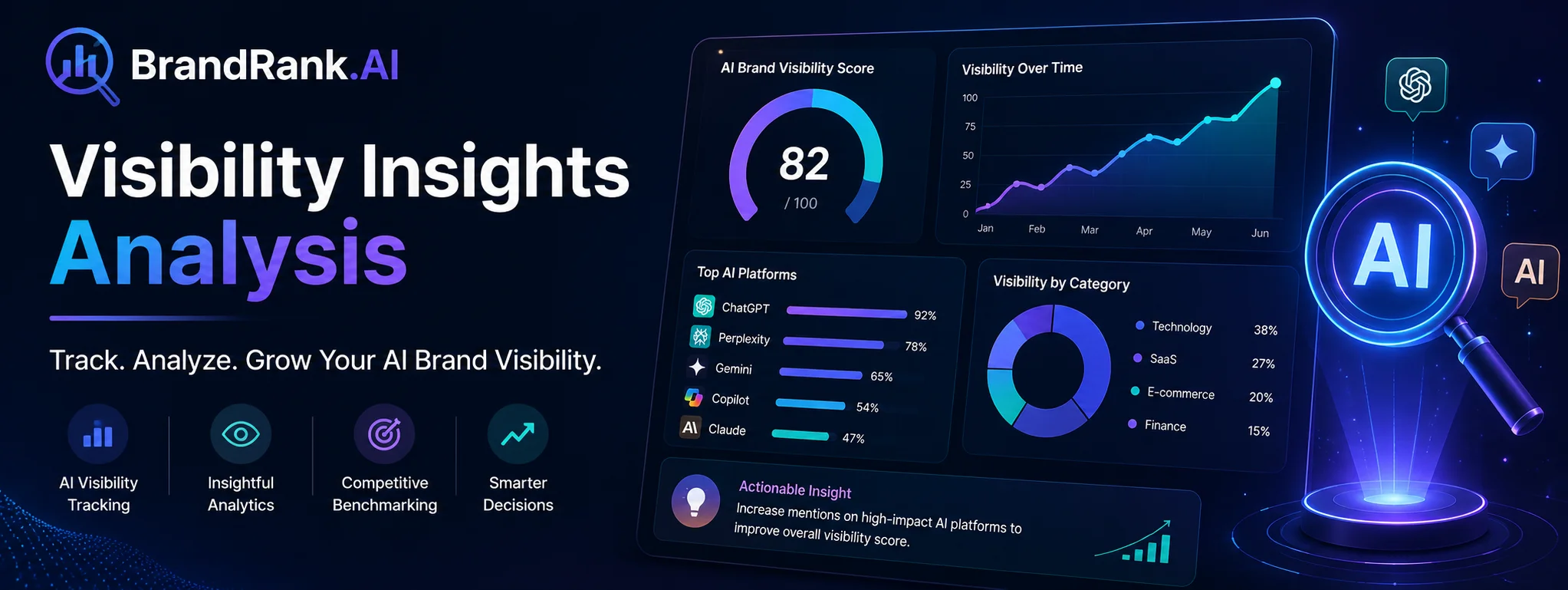
As people increasingly use AI assistants to research products, services, companies, and recommendations, brands face a new challenge: appearing in the answers generated by AI systems. Traditional SEO focuses heavily on rankings, clicks, and search-result positions, but AI platforms can answer a question without presenting a conventional list of links. This creates a different kind of visibility problem.
BrandRank.AI visibility insights analysis is designed around this emerging environment. The platform monitors how brands appear in AI-generated answers, evaluates visibility and content readiness, compares competitors, and identifies potential reputation risks. According to BrandRank.AI, its system tracks priority prompts across major AI answer engines, including ChatGPT, Gemini, Perplexity, Grok, Claude, Meta AI, and DeepSeek.
Understanding AI Brand Visibility
AI visibility refers to how frequently and prominently a company appears when people ask AI systems questions related to its category.
For example, someone might ask an AI assistant:
- Which project management software is best for small businesses?
- What is the most reliable running shoe brand?
- Which bank offers useful business services?
- What companies have strong customer support?
Instead of displaying ten traditional search results, an AI system may summarize information and recommend only a few brands.
That means being highly visible on Google does not automatically guarantee that a brand will be recommended by an AI assistant.
BrandRank.AI focuses on measuring this difference. Its platform describes visibility as a way of understanding whether a brand appears in AI-generated answers and how it compares with competitors.
How BrandRank.AI Visibility Insights Work
The platform uses priority prompts that represent important questions customers could ask. These prompts are tested across different AI answer engines, allowing businesses to observe differences between platforms.
The process can reveal several useful patterns. A company might appear frequently in ChatGPT but less often in Gemini, for example. Another brand may appear in answers but rarely be positioned as the preferred recommendation.
This distinction is important because simply being mentioned does not necessarily mean the AI considers a brand the strongest option.
BrandRank.AI therefore emphasizes Recommendation Share™, which is intended to measure how frequently a brand is actually recommended rather than merely mentioned.
The Main Insights Businesses Can Gain
A useful visibility analysis should go beyond a single score. It should help marketers understand why their brand is performing a certain way.
BrandRank.AI organizes its analysis around visibility, vulnerability, and content readiness.
| Insight Area | What It Helps Identify | Why It Matters |
|---|---|---|
| AI Search Visibility | Where and how often a brand appears | Shows whether customers can discover the brand through AI |
| Recommendation Share | Whether the brand is actually recommended | Helps measure competitive positioning |
| Content Readiness | Whether online information is accessible and useful to AI systems | Reveals content and structure gaps |
| Brand Vulnerability | Negative, inaccurate, outdated, or disputed information | Helps protect reputation |
| Competitive Positioning | Where competitors outperform the brand | Creates clearer optimization priorities |
These areas work together. A brand may have strong content but weak recommendation performance because competitors have stronger third-party authority. Conversely, a company might receive many mentions but still have a vulnerability problem if AI systems repeat outdated or inaccurate claims.
Content Readiness Is Becoming More Important
One of the most interesting elements of AI visibility analysis is content readiness.
Traditional SEO often emphasizes keywords, backlinks, technical optimization, and rankings. AI systems also need information that is clear, structured, accessible, and supported by credible sources.
BrandRank.AI describes content readiness through factors including content liquidity, search capital, and algorithmic anchors.
This means businesses should think carefully about how their important information is presented online.
Product descriptions, service explanations, frequently asked questions, company information, research, statistics, policies, and expert commentary should be clear enough for systems to understand and connect with relevant questions.
Poorly organized information can make it harder for AI systems to confidently use a brand as a source.
Competitor Analysis Adds Another Layer
Visibility becomes much more meaningful when it is compared with competitors.
Suppose a company appears in 35% of relevant AI responses. That number might initially seem impressive. However, if its primary competitor appears in 65% of the same prompts, the company has a significant visibility gap.
Competitive analysis helps identify the exact questions where another brand is winning.
This creates a more practical SEO and content strategy. Instead of publishing large amounts of generic content, marketing teams can focus on important topics where competitors consistently receive stronger AI recommendations.
Brand Risk and Accuracy
Another major advantage of AI visibility monitoring is the ability to detect potentially harmful information.
AI-generated responses can contain outdated information, incorrect associations, or claims that may not accurately represent a business. BrandRank.AI’s Brand Risk Monitor was launched in August 2026 to identify unfavorable AI answers and trace problematic claims back to external sources such as news, regulatory material, and independent publications.
This is particularly important for established companies.
A brand can invest heavily in marketing and still encounter an AI answer that repeats an old controversy or incorrectly associates a competitor’s problem with its products.
Monitoring these responses gives communication and marketing teams an opportunity to investigate the underlying information rather than simply reacting to the AI output.
Turning Insights Into Action
The most valuable visibility analysis is not simply a report full of numbers. Businesses need to turn findings into practical improvements.
If a brand is missing from important category questions, the first step is identifying what information competitors have that the brand lacks.
If the brand appears but is described inaccurately, teams should examine the sources that may be influencing the AI response.
If competitors dominate recommendation questions, improving authoritative content and third-party references may become a priority.
BrandRank.AI itself describes an improvement cycle involving strategically important questions, stronger evidence for priority claims, content-gap improvements, third-party authority, and repeated measurement.
Why This Matters for SEO Teams
AI visibility does not necessarily replace traditional SEO. Instead, it adds another measurement layer.
Google rankings remain important because many users continue to discover websites through conventional search. However, AI assistants increasingly influence research and recommendation behavior.
For SEO professionals, this means the objective is expanding from ranking a webpage to also ensuring that a brand’s information can be understood, supported, and referenced within AI-generated answers.
The strongest strategy combines traditional search optimization with useful content, authoritative sources, structured information, digital reputation management, and continuous AI-answer monitoring.
Final Thoughts
BrandRank.AI visibility insights analysis represents a broader shift in how digital visibility is measured. The important question is no longer only whether a website ranks for a keyword. Businesses also need to understand whether AI systems recognize their brand, recommend it, describe it accurately, and position it against competitors.