
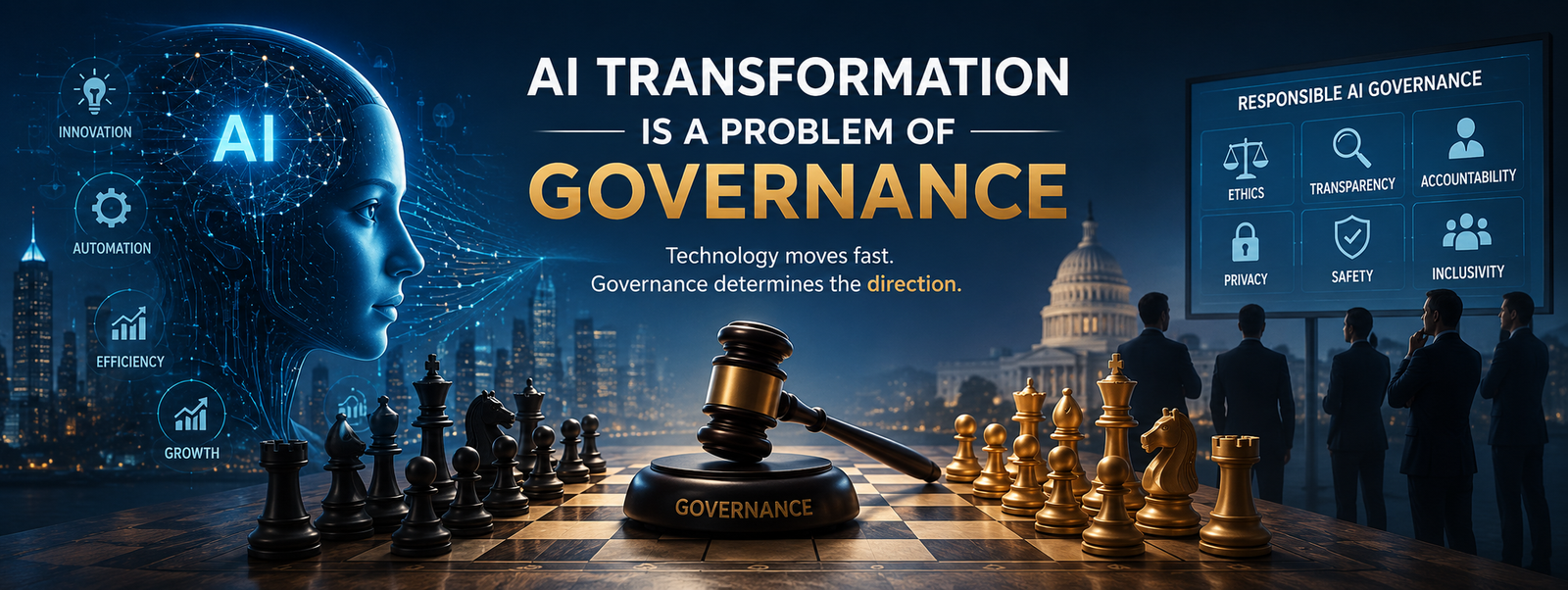
Artificial intelligence is changing how organizations work, make decisions, serve customers, and compete in the market. Companies are investing heavily in AI tools, automation, machine learning systems, and generative AI because these technologies can improve productivity and create new opportunities. Yet many organizations discover that adopting AI is easier than governing it.
The real challenge is not simply whether an organization can deploy AI. The harder question is whether it can use AI responsibly, consistently, securely, and in a way that supports its long-term objectives. This is why AI transformation is increasingly a problem of governance rather than technology alone.
Why AI Transformation Requires Governance
Traditional technology projects often have clear boundaries. A company selects a system, defines its users, establishes access controls, and measures performance. AI is different because many AI systems can influence decisions, generate content, process sensitive information, and change their behavior based on data and configuration.
Without appropriate governance, organizations may adopt AI faster than they can understand its consequences. Employees might use unapproved AI applications, confidential information could be entered into external systems, or automated decisions could produce inaccurate or unfair results.
Governance provides the structure needed to manage these risks while allowing innovation to continue.
AI Needs Clear Ownership
One of the biggest governance problems is unclear responsibility. When an AI system makes an error, organizations need to know who is accountable for identifying the problem and correcting it.
Responsibility should not be left entirely to the IT department. AI transformation usually affects legal, security, finance, human resources, marketing, operations, and senior management.
A strong governance structure defines who approves AI systems, who monitors them, who manages risks, and who has authority to stop an AI application when necessary.
Clear ownership also prevents a common problem: assuming that someone else is responsible.
Data Governance Becomes More Important
AI systems depend heavily on data. Poor-quality, outdated, biased, or improperly collected data can create unreliable results.
Organizations therefore need strong data governance before expanding AI adoption. This includes understanding where data comes from, who can access it, how long it is retained, and whether it can legally and ethically be used for AI applications.
Data governance should also cover sensitive business information. Employees need clear rules about what information can be entered into public AI services and what must remain inside approved company systems.
The goal is not to prevent employees from using AI. Instead, it is to create safe boundaries around its use.
Managing AI Risk
Every AI application does not carry the same level of risk. An internal tool that summarizes meeting notes is different from an AI system that helps evaluate job candidates, approve financial transactions, or provide information in a healthcare environment.
Organizations should classify AI applications according to their potential impact.
| Governance Area | Key Question | Practical Action |
|---|---|---|
| Data | What information does the AI use? | Classify data and restrict sensitive inputs |
| Security | Could the system expose company information? | Apply access controls and security testing |
| Accuracy | Can AI-generated results be trusted? | Use testing, human review, and monitoring |
| Accountability | Who is responsible for outcomes? | Assign clear owners for each AI system |
| Compliance | Does its use meet applicable requirements? | Conduct legal and regulatory reviews |
| Transparency | Can users understand how AI is being used? | Document AI systems and communicate their purpose |
This risk-based approach allows organizations to focus governance resources where they matter most.
Human Oversight Still Matters
AI can process enormous amounts of information quickly, but speed does not guarantee correctness. Generative AI can produce convincing information that is incomplete, inaccurate, or misleading.
For important decisions, human oversight remains essential.
Organizations should identify situations where employees must review AI-generated recommendations before action is taken. This does not mean humans need to manually check every AI output. Instead, oversight should be proportional to the potential consequences of an error.
A low-risk marketing draft may require simple editorial review. A high-impact financial or employment decision may require significantly stronger controls.
Creating an AI Policy Is Only the Beginning
Many companies create an AI policy and consider the governance problem solved. In practice, a policy is only the foundation.
Employees need training so they understand what the policy means in everyday work. Teams need approved tools that provide safe alternatives to unauthorized services. Managers need mechanisms for reporting problems, and technical teams need monitoring systems that can identify unusual behavior.
Governance must therefore become part of normal business operations rather than remaining a document stored in an internal knowledge base.
Governance Should Encourage Innovation
Good governance should not turn AI adoption into a slow approval process where every experiment requires multiple layers of bureaucracy.
Instead, organizations can establish different pathways for different types of AI use.
Low-risk experiments can receive faster approval, while high-risk applications receive deeper evaluation. Approved AI tools can be placed on internal platforms, giving employees convenient options that already meet security requirements.
This approach creates a balance between control and experimentation.
Building an AI-Ready Culture
Technology alone cannot create successful AI transformation. Employees need to understand both the possibilities and limitations of AI.
An AI-ready culture encourages people to ask questions such as:
- What problem are we trying to solve?
- Does AI provide the right solution?
- What data does this system require?
- What could happen if the output is wrong?
- Who reviews the result?
- How will we know whether the system is performing properly?
These questions shift AI adoption from simply buying technology to making responsible business decisions.
Measuring Governance Effectiveness
Organizations should also measure whether their AI governance framework is actually working.
Useful measurements can include the number of approved AI systems, employee training completion, security incidents, AI-related complaints, model performance, review frequency, and the time required to approve legitimate use cases.
The objective is not to eliminate every risk. No technology can operate without risk. The objective is to identify, reduce, monitor, and respond to risks before they become serious business problems.
The Future of AI Transformation
As AI becomes more deeply integrated into everyday operations, governance will become an ongoing discipline. Organizations will need to review systems as models, regulations, data sources, and business requirements change.
The companies most likely to benefit from AI will not necessarily be those that deploy the largest number of tools. They will be organizations that understand where AI creates value and establish sensible controls around its use.
AI transformation should therefore be viewed as an organizational change program supported by technology, not as a technology project with a small compliance layer added afterward.
Final Thoughts
AI transformation is ultimately a governance challenge because AI affects decisions, people, data, security, accountability, and organizational strategy. Technology provides the capabilities, but governance determines how those capabilities are used.
Organizations that establish clear ownership, protect data, manage risk, provide human oversight, train employees, and continuously monitor AI systems can create an environment where innovation and responsibility work together.