
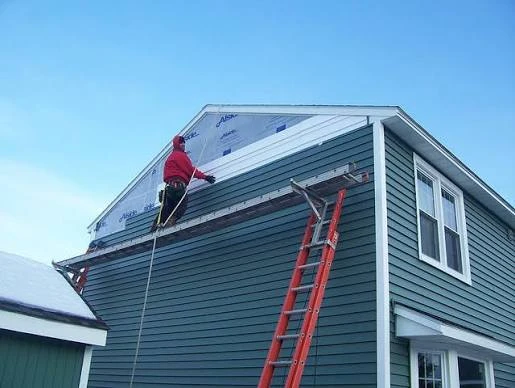
Typically exterior failures become visible years prior to the failure of the exterior envelope of a building. The challenge with most exterior failures is to determine if what you see is cosmetic or indicative of a possible drainage problem behind the cladding, or possibly that the end of the service life of the exterior assembly has occurred. Determining the above will determine the scope of work and budget for repairs as well as the possibility of paying for the same repairs in the future.
Symptoms that indicate assembly failure, not surface wear
Color fade and surface chalking are normal signs of aging on vinyl siding. The real signs of possible failure are signs of water movement and signs of stress on the fasteners behind the vinyl siding.
- Cupped, wavy, or buckled panels across a whole elevation, which usually means thermal movement was restrained by overdriven fasteners
- Rust or tannin staining bleeding down from nail lines on fiber cement or engineered wood
- Paint blistering from the substrate outward rather than peeling from a topcoat, indicating vapor pushing from inside the wall
- Soft spots at trim intersections, band boards, and the bottom course, found by probing with an awl rather than by eye
- Interior clues such as recurring mildew on the inside face of exterior walls, or nail pops in drywall along a single wall line
Confirm the moisture path before quoting a scope
Check behind the exterior cladding by pulling a few exterior panels (ideally from under corners of windows) and inspecting behind the cladding of the pulled panel for any signs of water intrusion behind the weather resistant barrier (WRB). Inspect flashing and check for proper lapping and that no damage exists to the sheathing.
Deciding between repair, partial replacement, and full re-clad
25% of surface area is worst case scenario. In other words, damage to exterior wall of more than 25% of single face of wall (approximately 1/4 of an elevation) will likely cost more to repair that portion of wall than to retreat entire face of wall and, if necessary, replace entire elevation of siding. The constraint of color matching of weathered siding also affects scope of repair.
| Scope | Trigger conditions | Main risk |
| Targeted repair | Isolated impact damage, one leaking penetration, sound sheathing | Visible mismatch and unresolved water entry upstream |
| Single elevation replacement | One face weathered or wet, others intact, profile still available | Tonal difference between old and new faces |
| Full re-clad | Widespread fastener failure, no or failed weather barrier, cladding past service life | Scope creep once sheathing is exposed, so carry a contingency |
Material selection under real climate loads
Exterior exposures (such as humid, coastal, wind-driven rain areas) require special consideration for siding choice (such as Vinyl Siding). Other exposures, such as shaded north walls, may require different material choices (such as Fiber Cement Siding). In addition, urban lots with high reflected heat may require special consideration for siding colors (such as not using very dark colors for Vinyl Siding).
Trade-offs worth stating plainly to a homeowner
Fiber cement siding is very dimensionally stable and holds paint well. It is however extremely heavy and difficult to cut. Therefore, fiber cement is not the best choice for exterior siding, unless absolutely necessary. There are many other choices on the market today. The cost of installation of Fiber Cement Siding is much higher than other choices on the market today. Another choice for exterior siding that has improved impact resistance and overall wall performance is Insulated Vinyl. This siding has only a slightly higher cost than Vinyl Siding. Engineered wood is the fastest installing of all the exterior siding materials listed. The engineered wood can accept fasteners easily and allows for sealant to be placed in the corresponding cut edges, as specified. Aluminum is still the best choice for soffit and fascia installation, due to its superior fire performance.
Evaluating a contractor by the details in the proposal
The cost for siding replacement can vary dramatically depending on the details behind the pricing for identical square footage. Homeowners weighing a siding replacement Annapolis crews can stand behind should compare proposals line by line rather than by bottom-line price alone. Ask for a list of the details in their installation process such as the type of water-resistive barrier, type of flashing, type of fasteners, and the spacing of the fasteners. Will there be a drainage gap created behind the new siding?
- Written confirmation that the manufacturer’s installation instructions govern, since warranties depend on them
- A named allowance for sheathing replacement and rot repair, with a unit price
- Kickout flashing at every roof-to-wall termination, called out by location
- Clearances at grade, roofing, and decks, stated as measurements
- Proof of insurance, permit responsibility, and a lien waiver process at closeout
Maintenance that extends the next assembly’s life
New siding will last twenty to forty years. Keep the exterior of your home in good shape by checking the sealants at openings, making sure gutters and downspouts are functioning properly, and keeping grade and mulch at the proper distance from exterior walls of your house.
Keep surfaces clean with low pressure washes on shaded surfaces. Keep grade and mulch below specified clearances. Regularly apply caulk to trim joints. By recording the water-resistive barrier and flashing details used in a new exterior surface, future repairs will be much easier.