
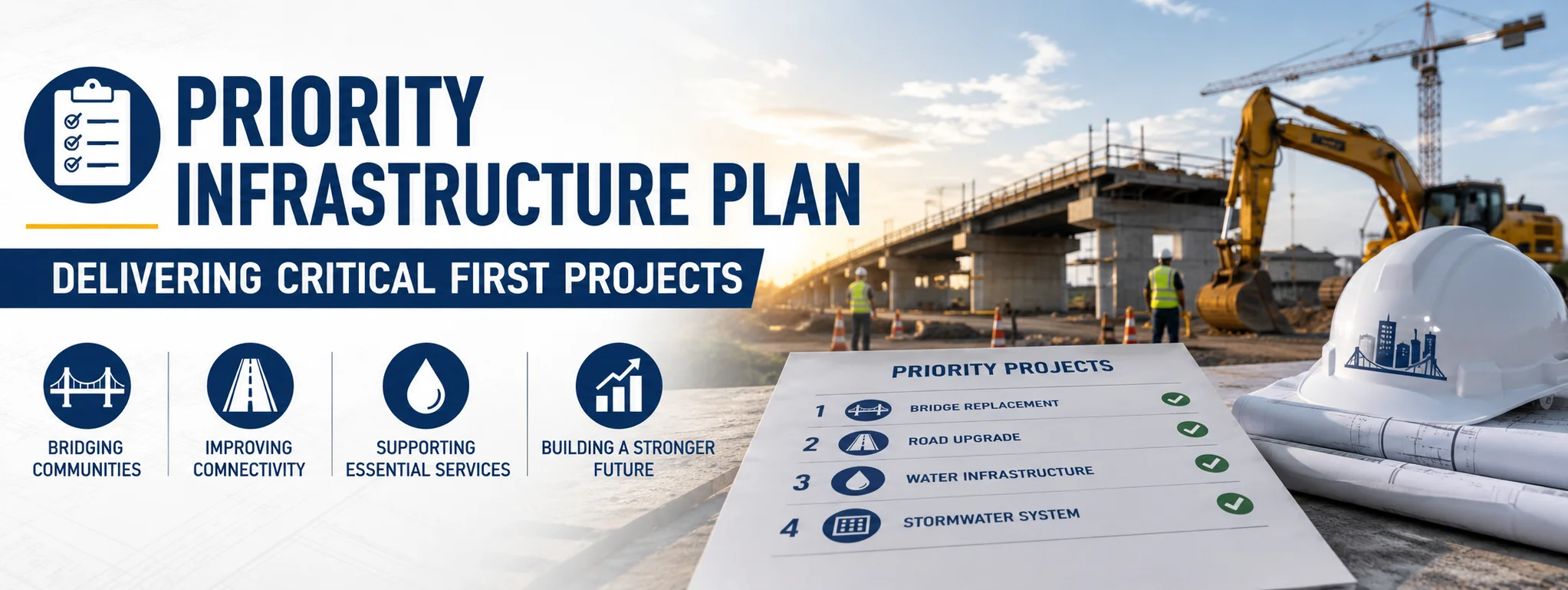
A Priority Infrastructure Plan (PIP) is a strategic planning document, primarily used in urban and regional development (especially in Queensland, Australia), that coordinates land use growth with the timely delivery of essential “trunk” infrastructure.
How Projects Are Selected
Projects in a Priority Infrastructure Plan (PIP) are selected through a structured, data-driven prioritization process that balances urgency, impact, feasibility, and available resources. The goal is to focus limited funding on initiatives that deliver the highest value for urban growth, sustainability, and service delivery.
Typical Selection and Prioritization Criteria
Alignment with Planning Assumptions
Projects must directly support projected population, employment, and development needs within the designated Priority Infrastructure Area (PIA) across the defined long-term planning horizon (typically 10–20 years).
Cost-Benefit Analysis (CBA)
Rigorous evaluation of macro-economic returns, calculated across tangible metrics including traffic congestion reduction, community livability improvements, and multi-decade structural cost savings.
Demand and Capacity Gaps
Identification based on current infrastructure shortfalls and future assessable demand. This is measured precisely in unified units like equivalent tenements for water/sewage or trip ends for transit systems.
Desired Standards of Service (DSS)
Prioritizing structural initiatives that actively bridge gaps to achieve defined performance benchmarks, such as road networks peak capacity, network water pressure, and complex stormwater management standards.
ESG and Sustainability Factors
Comprehensive assessment of environmental footprints, systemic social equity, localized climate resilience, and strict alignment with overarching modern smart city integration or disaster mitigation goals.
Multi-Criteria Scoring Frameworks
Utilization of standardized scoring toolsets, such as the World Bank’s Infrastructure Prioritization Framework (evaluating Social-Environmental vs. Financial-Economic Indices) or Weighted Shortest Job First (WSJF) formulas to rank execution paths based on maximum value and low delivery risk.
Phasing and Sequencing Optimization
Projects are algorithmically scheduled in highly logical operational phases so that physical infrastructure becomes available just-in-time for real estate development, eliminating structural capital waste and municipal disruption.
Stakeholder Input and Feasibility
Final verification of engineering viability, localized land availability, diversified funding structures (including infrastructure charges, state budgets, and Public-Private Partnerships), and structured public consultations.
Current Major Projects
Current major projects under Priority Infrastructure Plans (or successor LGIPs) focus on supporting population growth, improving connectivity, and enhancing resilience, particularly in high-growth areas like South East Queensland. These are typically drawn from local government schedules of works and state pipelines. Examples (as of 2026) include:
Gold Coast and South East Queensland Highlights
Gold Coast Light Rail (Stages 3 and 4)
Strategic mass transit extensions adding new stations and dramatically improving north-south coastal connectivity. Stage 3 is actively under physical delivery with significant localized investment earmarked for extensive tram testing and immediate corridor operations.
Coomera Connector Corridor
A major new arterial road project acting as a secondary critical M1 corridor bypass. Engineered specifically to relieve heavy highway congestion and support rapid high-density urban expansion across the greater Coomera region.
Heavy Rail and Public Transport Upgrades
Trunk transit expansions extending directly to the Gold Coast Airport, implementation of high-frequency feeder bus networks (including the Broadbeach to Robina link via Bond University), and major rail capacity structural upgrades centered in Coomera.
Stormwater, Water, and Sewerage Trunk Networks
Comprehensive utility infrastructure scaling designed to service incoming greenfield residential and mixed-use commercial masterplans, heavily detailed within the current LGIP schedules of civil works.
Parks and Public Community Facilities
Targeted municipal land acquisitions and civil developments earmarked for open space preservation, environmental corridors, and active recreational amenities to scale symmetrically with regional population density spikes.
Future Outlook
The future of Priority Infrastructure Plans points toward more dynamic, resilient, and technology-enabled planning amid rapid urbanization, climate challenges, and economic pressures.
Emerging Structural Trends
Longer-Term and Adaptive Planning
Horizons extending beyond 15–20 years with structural reviews powered by real-time spatial data, AI-driven demand forecasting models, and flexible scenario mapping for unexpected climate and population shifts.
Climate Resilience and Sustainability
Substantial integration of ESG criteria and nature-based engineering solutions. Future capital projects must explicitly prove long-term carbon efficiency and structural adaptability to extreme weather patterns.
Digital and Smart Infrastructure Networks
Systemic deployment of industrial IoT sensor matrices and municipal digital twins, categorizing digital connectivity networks as essential core utility assets alongside water and transport pipelines.
Funding and Capital Innovation
Increased utilization of progressive value-capture frameworks, green municipal bonds, and diversified Public-Private Partnerships (PPPs) alongside evolution of localized infrastructure charges and offset mechanisms.
Mega-Events Alignment
Strategic sequencing within Queensland pipelines to seamlessly accelerate regional infrastructure supporting the Brisbane 2032 Olympics, while simultaneously addressing broader housing density and regional equity.
Advanced Data-Driven Prioritization
Wider application of complex international multi-criteria scoring indexes (e.g., World Bank IPF or WSJF) paired with granular GIS and multimodal network analysis to isolate high-value project pipelines.
Macro Challenges & Opportunities
Growth & Resource Pressures
High-growth municipal councils face immediate friction balancing the structural expansion of Priority Infrastructure Areas (PIAs) with long-term fiscal affordability. This challenge is multiplied by acute specialized workforce shortages and ongoing macroeconomic supply chain delays that alter planned asset delivery timelines.
Economic Transformation
Precision execution of modern PIPs and LGIPs serves as a powerful engine for long-term regional economic recovery. Symmetrically scaling trunk utility networks with structural urbanization actively elevates community livability benchmarks, positioning urban corridors competitively for global capital investment.
Comparison with Previous Plans
Priority Infrastructure Plans (PIPs) and their successors, such as Local Government Infrastructure Plans (LGIPs), represent an evolution in Queensland’s (and broader Australian) infrastructure planning. The shift moves from reactive engineering to evidence-based, publicly accountable frameworks.
Key Improvements Over Previous Plans
Transparency & Accountability
Older PIPs under the Integrated Planning Act lacked granular public justification. Modern LGIPs introduce rigid legislative mandates for public planning assumptions, independent financial sustainability audits, and exact tracking of infrastructure expenditures.
Land Use Integration
Historical frameworks operated as isolated, reactive utilities. Current blueprints explicitly tie demographic expansion spikes (population, corporate employment, net developable land) directly to trunk infrastructure delivery inside strict Priority Infrastructure Areas (PIA).
Planning Horizons & Data
ABS / QGSO AlignmentSuperseding obsolete static demographic tracking, current pipelines integrate real-time data feeds from the Australian Bureau of Statistics (ABS) and the Queensland Government Statistician’s Office (QGSO), paired with deep multimodal transport modeling.
Financial Rigor & Caps
Simplistic cost-recovery systems have been entirely replaced with algorithmic baseline tracking. Modern frameworks evaluate precise asset establishment costs, systemic discounting matrices, developer credit offsets, and legislative caps.
Scope & Service Standards
Expanded integration of standardized Desired Standards of Service (DSS) benchmarks alongside next-generation digital networks, ensuring seamless regional coordination with macro blueprints like the South East Queensland Regional Plan.
Limitations and Continuities
Systemic Benchmarks
Core mechanisms including the foundational Plans for Trunk Infrastructure (PFTI) and formalized development infrastructure charge frameworks remain functional mainstays, preserving structural continuity across legislative updates.
Capital Friction points
Persistent global macroeconomic challenges remain regarding macro-scale asset delivery timelines, compounding material cost escalations, and widening capital funding deficits for greenfield growth emerging outside designated PIA rings.
Dynamic Amendments
Static planning cycles have evolved into fluid, rolling adjustments. Councils now run frequent, localized amendments to pivot alongside post-pandemic decentralization markers and pressing Brisbane 2032 Olympic commitments.
Future Outlook
The future of Priority Infrastructure Plans points toward more dynamic, resilient, and technology-enabled planning amid rapid urbanization, climate challenges, and economic pressures.
Emerging Structural Trends
Longer-Term and Adaptive Planning
Horizons extending beyond 15–20 years with structural reviews powered by real-time spatial data, AI-driven demand forecasting models, and flexible scenario mapping for unexpected climate and population shifts.
Climate Resilience and Sustainability
Substantial integration of ESG criteria and nature-based engineering solutions. Future capital projects must explicitly prove long-term carbon efficiency and structural adaptability to extreme weather patterns.
Digital and Smart Infrastructure Networks
Systemic deployment of industrial IoT sensor matrices and municipal digital twins, categorizing digital connectivity networks as essential core utility assets alongside water and transport pipelines.
Funding and Capital Innovation
Increased utilization of progressive value-capture frameworks, green municipal bonds, and diversified Public-Private Partnerships (PPPs) alongside evolution of localized infrastructure charges and offset mechanisms.
Mega-Events Alignment
Strategic sequencing within Queensland pipelines to seamlessly accelerate regional infrastructure supporting the Brisbane 2032 Olympics, while simultaneously addressing housing density and regional equity.
Advanced Data-Driven Prioritization
Wider application of complex international multi-criteria scoring indexes (e.g., World Bank IPF or WSJF) paired with granular GIS and multimodal network analysis to isolate high-value project pipelines.
Macro Challenges & Opportunities
Growth & Resource Pressures
High-growth municipal councils face immediate friction balancing the structural expansion of Priority Infrastructure Areas (PIAs) with long-term fiscal affordability. This challenge is multiplied by acute specialized workforce shortages and ongoing macroeconomic supply chain delays that alter planned asset delivery timelines.
Economic Transformation
Precision execution of modern PIPs and LGIPs serves as a powerful engine for long-term regional economic recovery. Symmetrically scaling trunk utility networks with structural urbanization actively elevates community livability benchmarks, positioning urban corridors competitively for global capital investment.
Frequently Asked Questions
What is the main difference between a PIP and an LGIP?
The Local Government Infrastructure Plan (LGIP) is the modern, more rigorously audited successor to the older Priority Infrastructure Plan (PIP). It introduces stricter legislative compliance metrics, regularized financial sustainability checks, and updated demographic modeling forecasts.
What exactly is a Priority Infrastructure Area (PIA)?
A PIA is a designated growth boundary ring within a municipality engineered to handle urban development over a rolling 10 to 15-year period. It ensures that essential trunk networks are delivered systematically, preventing speculative infrastructure capital waste.
How are specific projects prioritized for capital deployment?
Councils utilize structured multi-criteria decision models—such as the World Bank's Infrastructure Prioritization Framework or Weighted Shortest Job First (WSJF) formulas—to score projects based on asset demand gaps, cost-benefit ratios, and low delivery risk profiles.
What networks are covered under Desired Standards of Service (DSS)?
The framework regulates core trunk networks including high-capacity transport links, public stormwater catchments, water distribution pipelines, sewerage network assets, and dedicated public parklands or civic recreational spaces.
How are upcoming regional mega-events affecting these pipelines?
In regions like South East Queensland, current networks are undergoing rapid structural reviews and amendments to align infrastructure scheduling directly with the Brisbane 2032 Olympics requirements while balancing long-term housing affordability.