
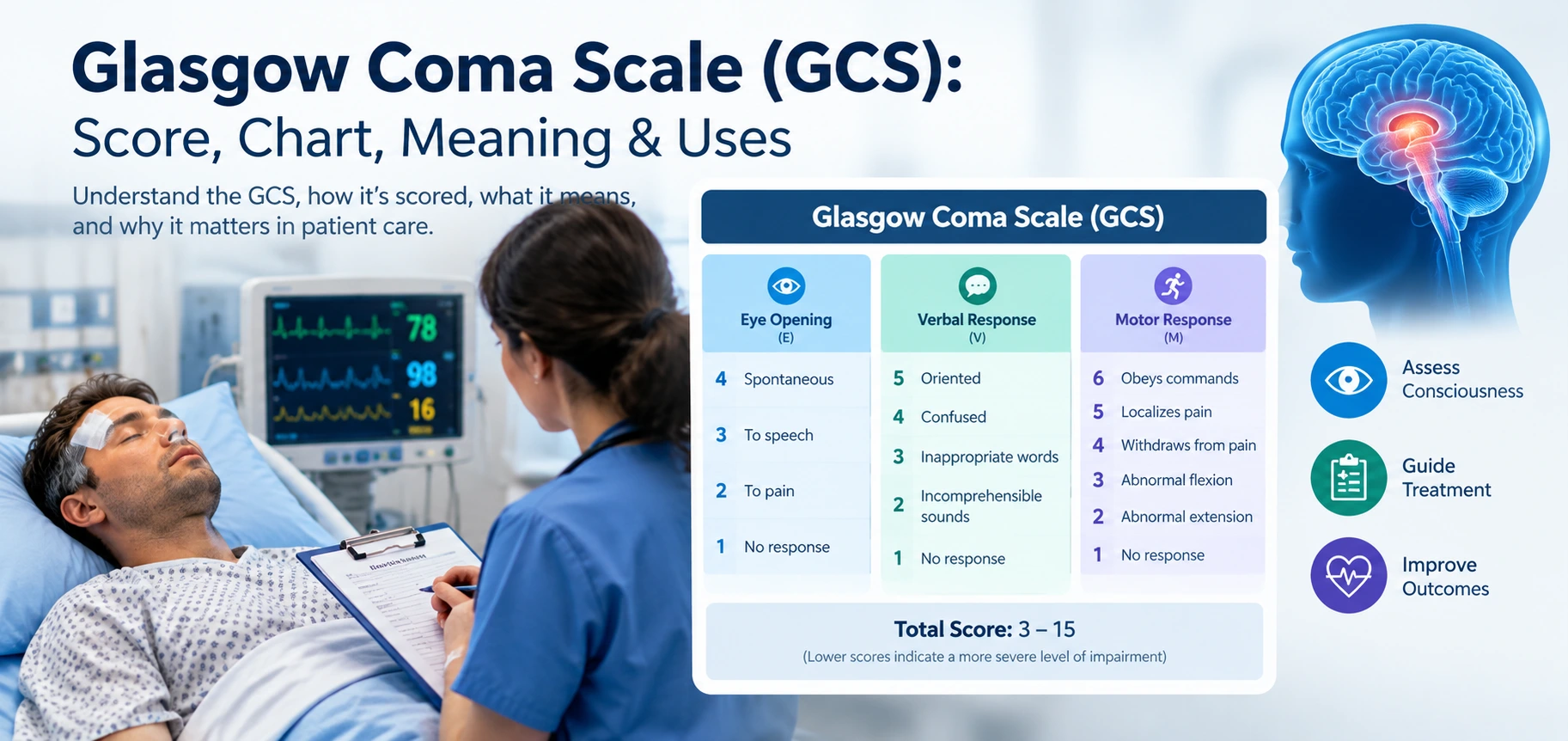
The Glasgow Coma Scale (GCS) is a clinical assessment tool used by healthcare professionals to describe a person’s level of consciousness. It evaluates three types of responses: eye opening, verbal response, and motor response.
The scale was developed in 1974 by neurosurgeons Graham Teasdale and Bryan Jennett at the University of Glasgow. It was originally designed to help describe consciousness in patients with acute brain injury and is now widely used in emergency medicine, trauma care, neurology, intensive care, and other clinical settings.
A GCS score ranges from 3 to 15. However, healthcare professionals should interpret the individual eye, verbal, and motor responses as well as the total score because the individual components provide important clinical information.
Important: The Glasgow Coma Scale is a clinical assessment performed by trained healthcare professionals. A GCS score should not be used by itself to diagnose a condition or predict an individual’s outcome.
What Is the Glasgow Coma Scale?
The Glasgow Coma Scale is a standardized method for assessing impaired consciousness.
It examines three areas:
- Eye response (E)
- Verbal response (V)
- Motor response (M)
Each component receives a numerical score. The three numbers can then be added to produce a total GCS score.
For example:
E4 + V5 + M6 = GCS 15
Healthcare professionals may record the complete result as E4 V5 M6 rather than reporting only “GCS 15.” This provides more information about the person’s actual responses.
Glasgow Coma Scale Chart
| Component | Response | Score |
|---|---|---|
| Eye | Spontaneous | 4 |
| To sound | 3 | |
| To pressure | 2 | |
| None | 1 | |
| Verbal | Oriented | 5 |
| Confused | 4 | |
| Words | 3 | |
| Sounds | 2 | |
| None | 1 | |
| Motor | Obeys commands | 6 |
| Localizes | 5 | |
| Normal flexion | 4 | |
| Abnormal flexion | 3 | |
| Extension | 2 | |
| None | 1 |
These are the standard component scores used in the modern structured GCS assessment.
1. Eye Response
The eye component evaluates whether and when a person opens their eyes.
E4 — Spontaneous
The person’s eyes are open without needing stimulation.
E3 — To Sound
The person opens their eyes after being spoken to or otherwise receiving an appropriate sound stimulus.
E2 — To Pressure
The person opens their eyes only after physical pressure is applied as part of the clinical assessment.
E1 — None
The person does not open their eyes.
The modern structured approach uses the terms “to sound” and “to pressure” rather than the older terminology involving “pain.”
2. Verbal Response
The verbal component assesses speech and aspects of awareness and orientation.
V5 — Oriented
The person can appropriately answer questions about themselves, their surroundings, and time.
V4 — Confused
The person can communicate but demonstrates confusion or disorientation.
V3 — Words
The person produces understandable words, but the responses are not appropriately oriented to questions.
V2 — Sounds
The person produces sounds but not understandable words.
V1 — None
There is no verbal response.
The Cleveland Clinic describes the verbal component as assessing areas including thinking, memory, attention and awareness.
3. Motor Response
The motor component evaluates movement and the person’s ability to follow commands or respond to stimulation.
M6 — Obeys Commands
The person follows an instruction to move.
M5 — Localizes
The person makes an intentional movement toward or away from the stimulus.
M4 — Normal Flexion
The person withdraws from pressure with a flexion response.
M3 — Abnormal Flexion
The person demonstrates an abnormal flexion response.
M2 — Extension
The person demonstrates an extension response.
M1 — None
There is no motor response to the appropriate stimulus.
The motor component has six possible scores, making it the highest-scoring individual component of the GCS.
How Is a GCS Score Calculated?
The three component scores are added together.
GCS = Eye + Verbal + Motor
For example:
- Eye = 4
- Verbal = 5
- Motor = 6
Therefore:
4 + 5 + 6 = 15
The highest possible total is 15, while the lowest is 3.
A complete clinical record may therefore look like:
GCS 15 = E4 V5 M6
This is more informative than writing only “15.”
What Do GCS Scores Mean?
The total score provides a general description of the person’s level of responsiveness.
| Total GCS | Common interpretation in head injury |
|---|---|
| 13–15 | Mild traumatic brain injury |
| 9–12 | Moderate traumatic brain injury |
| 3–8 | Severe traumatic brain injury |
These ranges are commonly used when GCS is being applied to head injury/TBI severity. They should not be interpreted as a complete description of a person’s medical condition.
The official Glasgow Coma Scale site also notes that a total score alone contains less information than the three individual component responses.
What Does a GCS Score of 15 Mean?
A GCS of 15 represents the highest possible total score.
For example:
E4 V5 M6 = 15
This means the person demonstrated the highest-scoring eye, verbal, and motor responses during that assessment.
It does not mean that every aspect of neurological function is normal, nor does the score alone establish a diagnosis.
What Does a GCS Score of 8 Mean?
A GCS of 8 or less is commonly associated with coma in clinical descriptions.
However, clinicians need to examine the individual components and the circumstances surrounding the assessment.
For example, a person’s verbal response may be impossible to assess because they are intubated. In that situation, the official GCS guidance recommends documenting the verbal component as NT (not testable) rather than automatically assigning it a score of 1.
Why Are the Individual GCS Components Important?
Two people can have the same total score while having different combinations of eye, verbal, and motor responses.
For that reason, the official Glasgow Coma Scale guidance recommends describing the three component responses rather than communicating only the total.
For example:
E2 V3 M4
contains considerably more clinical information than simply reporting:
GCS 9
This is one reason healthcare professionals record the component scores separately.
When Is the Glasgow Coma Scale Used?
Healthcare professionals can use the GCS when assessing reduced consciousness.
Examples include:
- Traumatic brain injury
- Head injury
- Concussion assessment
- Coma
- Certain neurological emergencies
- Poisoning
- Low blood sugar
- Following seizures
- Other situations involving impaired consciousness
The Cleveland Clinic specifically describes its use in both injury-related and non-injury-related conditions.
GCS in Traumatic Brain Injury
The GCS is particularly important in trauma medicine.
Following a head injury, healthcare professionals may repeat the assessment to determine whether responsiveness is:
- Improving
- Stable
- Worsening
Changes over time can provide clinically useful information.
The GCS is therefore not simply a one-time measurement. Repeated assessments can help clinicians monitor changes in consciousness.
What Is GCS-P?
GCS-P is a modification of the Glasgow Coma Scale that incorporates pupil reactivity.
The “P” refers to pupils.
The GCS-P combines the standard GCS score with a pupil reactivity score. Cleveland Clinic notes that the pupil score ranges from 0 to 2 and is subtracted from the standard GCS score.
In simplified form:
GCS-P = GCS − Pupil Reactivity Score
This provides additional information about neurological status beyond the standard three-component GCS.
Why Was “Pain” Changed to “Pressure”?
Older descriptions of the Glasgow Coma Scale commonly used the term painful stimulus.
The modern structured approach uses pressure instead.
The change helps describe the actual examination technique more accurately and avoids suggesting that clinicians are trying to cause injury or pain.
Examples of clinically used pressure sites include:
- Fingertip/nail bed
- Trapezius region
- Supraorbital notch
These examinations should be performed by appropriately trained healthcare professionals.
What Can Affect a GCS Assessment?
A person’s response may be affected by factors other than the underlying neurological condition.
Examples include:
- Sedative medications
- Paralytic medications
- Intubation
- Hearing impairment
- Language differences
- Vision impairment
- Spinal cord injury
- Other physical injuries
- Alcohol or drug effects
- Metabolic problems
The official GCS guidance recommends identifying factors that can interfere with assessment and documenting when a component cannot be tested.
GCS and Intubated Patients
An intubated patient may not be able to produce a normal verbal response because of the endotracheal tube.
In these circumstances, the official GCS guidance recommends recording the verbal component as NT (Not Testable) rather than assigning it a score of 1 simply because the patient cannot speak.
This distinction matters because artificially assigning a low verbal score can make the total GCS appear lower than the patient’s actual neurological responsiveness.
Limitations of the Glasgow Coma Scale
Although the GCS is widely used, it has limitations.
The scale may be difficult to apply when:
- A patient is intubated
- Communication is limited
- Hearing or vision is impaired
- Sedatives affect responsiveness
- Paralytic drugs have been administered
- There are injuries affecting movement
- Language differences interfere with verbal assessment
The Cleveland Clinic also emphasizes that the GCS is only one part of a neurological evaluation and should not be used alone to determine prognosis.
Is the GCS the Same as a Coma Diagnosis?
No.
The Glasgow Coma Scale is an assessment tool, not a complete diagnosis.
A score describes responses observed during an examination.
Healthcare professionals consider the GCS alongside:
- Medical history
- Neurological examination
- Imaging
- Vital signs
- Laboratory testing
- Medication effects
- Other clinical findings
A single number cannot describe every aspect of brain function or determine an individual’s long-term outcome.
Glasgow Coma Scale Example
Imagine a patient produces the following responses during a clinical assessment:
- Opens eyes spontaneously → E4
- Answers questions appropriately → V5
- Follows movement commands → M6
The total is:
4 + 5 + 6 = 15
The clinical record would be:
GCS 15 (E4 V5 M6)
Another patient could have a lower total with a completely different response pattern, which is why documenting the individual components is important.
GCS Score vs. GCS Components
| Reporting method | Information provided |
|---|---|
| GCS 15 | Total score only |
| E4 V5 M6 | Individual responses |
| GCS 12 | Total score only |
| E3 V4 M5 | Individual responses |
The component scores are more descriptive than the total alone. The official Glasgow Coma Scale guidance specifically recommends communicating the three responses in clinical practice.
Frequently Asked Questions
What does GCS stand for?
GCS stands for Glasgow Coma Scale.
What are the three parts of the GCS?
The three components are eye response, verbal response, and motor response.
What is the highest GCS score?
The highest possible total GCS score is 15.
What is the lowest GCS score?
The lowest possible total is 3.
What does a GCS score of 15 mean?
It represents the highest possible eye, verbal, and motor responses during the assessment: E4 V5 M6.
What does GCS 3 mean?
GCS 3 is the lowest possible total and corresponds to E1 V1 M1. It indicates no eye, verbal, or motor response during the assessment.
Is GCS 8 a coma?
A GCS of 8 or less is generally used to describe coma, but the complete clinical situation and individual component scores must be considered.
Is the Glasgow Coma Scale only used for head injuries?
No. It can also be used when consciousness is reduced for other reasons, including certain cases involving low blood sugar, poisoning, or seizures.
Can someone have a GCS if they are intubated?
Yes, but the verbal component may be not testable (NT). The official GCS guidance recommends not automatically assigning a score of 1 to an untestable component.
Can I calculate my own GCS?
The GCS is designed as a clinical assessment. A person without appropriate training should not attempt to stimulate an unresponsive person or use a GCS number as a substitute for emergency medical assessment.
If someone is suddenly unconscious, difficult to wake, or has a significant head injury, seek emergency medical care rather than trying to determine the GCS yourself.
Final Thoughts
The Glasgow Coma Scale is a standardized clinical tool for describing a person’s level of consciousness through eye, verbal, and motor responses. It produces a total score from 3 to 15, but the individual component scores are clinically important and should be documented whenever possible.
For traumatic brain injury, GCS scores of 13–15, 9–12, and 3–8 are commonly used to describe mild, moderate, and severe injury categories, respectively.
The most important point is that GCS is not a complete diagnosis or a standalone prediction of outcome. Healthcare professionals interpret it alongside the patient’s history, neurological examination, medications, injuries, imaging, and other clinical findings.